Sedimentary Rocks and Resources


Sedimentary Rocks and Resources
Contents of Entire Course
Introduction to Sedimentary rocks
Clastic Sediments
Textures of Clastic Sedimentary
Rocks
Chemical Sediments and
Sedimentary Rocks
Biogenic Sediments and
Sedimentary Rocks
Features of
Sedimentary Rocks That Give Clues to the Environment of Deposition
Stratification and Bedding
Sedimentary Facies
Common Sedimentary Environments
adapted to HTML from lecture notes of Prof. Stephen A. Nelson Tulane
University
Introduction to sedimentary rocks
Rivers, oceans, winds, and rain runoff all have the ability to carry the particles washed off of eroding rocks. Such material, called detritus, consists of fragments of rocks and minerals. When the energy of the transporting current is not strong enough to carry these particles, the particles drop out in the process of sedimentation. This type of sedimentary deposition is referred to as clastic sedimentation. Another type of sedimentary deposition occurs when material is dissolved in water, and chemically precipitates from the water. This type of sedimentation is referred to as chemical sedimentation. A third process can occur, wherein living organisms extract ions dissolved in water to make such things as shells and bones. This type of sedimentation is called biogenic sedimentation. Thus, there are three major types of sedimentary rocks: Clastic sedimentary rocks, chemical sedimentary rocks, and biogenic sedimentary rocks.

Clastic Sediments
Classification - Clastic sedimentary particles are classified in terms of
size
| Name of Particle | Size Range | Loose Sediment | Consolidated Rock |
|---|---|---|---|
| Boulder | >256 mm | Gravel | Conglomerate or Breccia (depends on rounding) |
| Cobble | 64 - 256 mm | Gravel | |
| Pebble | 2 - 64 mm | Gravel | |
| Sand | 1/16 - 2mm | Sand | Sandstone |
| Silt | 1/256 - 1/16 mm | Silt | Siltstone |
| Clay | <1/256 mm | Clay | Claystone, mudstone, and shale |
The formation of a clastic sedimentary rock involves three processes:
Transportation- Sediment can be transported by sliding down slopes, being picked up by the wind, or by being carried by running water in streams, rivers, or ocean currents. The distance the sediment is transported and the energy of the transporting medium all leave clues in the final sediment of the mode of transportation.
Deposition - Sediment is deposited when the energy of the transporting medium becomes too low to continue the transport process. In other words, if the velocity of the transporting medium becomes to low to transport sediment, the sediment will fall out and become deposited. The final sediment thus reflects the energy of the transporting medium. Diagenesis - Diagenesis is the process that turns sediment into rock. The first stage of the process is compaction. Compaction occurs as the weight of the overlying material increases. Compaction forces the grains closer together, reducing pore space and eliminating some of the contained water. Some of this water may carry mineral components in solution, and these constituents may later precipitate as new minerals in the pore spaces. This causes cementation, which will then start to bind the individual particles together. Further compaction and burial may cause recrystallization of the minerals to make the rock even harder. Other conditions present during diagenesis, such as the presence of absence of free oxygen may cause other alterations to the original sediment. In an environment where there is excess oxygen (Oxidizing Environment) organic remains will be converted to carbon dioxide and water. Iron will change from Fe2+ to Fe3+, and will change the color of the sediment to a deep red (rust) color. In an environment where there is a depletion of oxygen (Reducing Environment), organic material may be transformed to solid carbon in the form of coal, or may be converted to hydrocarbons, the source of petroleum.
Textures of Clastic Sedimentary Rocks
When sediment is transported and deposited, it leaves clues to the mode of transport and deposition. For example, if the mode of transport is by sliding down a slope, the deposits that result are generally chaotic in nature, and show a wide variety of particle sizes. Grain size and the interrelation ship between grains gives the resulting sediment texture. Thus, we can use the texture of the resulting deposits to give us clues to the mode of transport and
deposition.
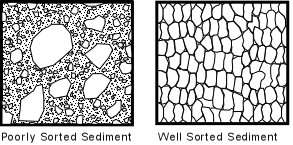
Sorting - The degree of uniformity of grain size. Particles become sorted on the basis of density, because of the energy of the transporting medium. High energy currents can carry larger fragments. As the energy decreases, heavier particles are deposited and lighter fragments continue to be transported. This results in sorting due to density.
If the particles have the same density, then the heavier particles will also be larger, so the sorting will take place on the basis of size. We can classify this size sorting on a relative basis - well sorted to poorly sorted. Sorting gives clues to the energy conditions of the transporting medium from which the sediment was deposited. Examples
- Beach deposits and wind blown deposits generally show good sorting because the energy of the transporting medium is usually constant.
- Stream deposits are usually poorly sorted because the energy (velocity) in a stream varies with position in the stream.
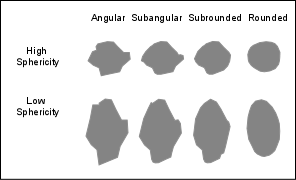
Rounding- During the transportation process, grains may be reduced in size due to abrasion. Random abrasion results in the eventual rounding off of the sharp corners and edges of grains. Thus, rounding of grains gives us clues to the amount of time a sediment has been in the transportation cycle. Rounding is classified on relative terms as well.
Chemical Sediments and Sedimentary Rocks Cherts
- chemically precipitated SiO2
Evaporites - formed by evaporation of sea water or lake water. Produces halite (salt) and gypsum deposits by chemical precipitation as concentration of solids increases due to water loss by evaporation.
Biogenic Sediments and Sedimentary Rocks
Limestone - calcite (CaCO3) is precipitated by organisms usually to form a shell or other skeletal structure. Accumulation of these skeletal remains results in a limestone. Diatomite - Siliceous ooze consisting of the remains of radiolarian or diatoms can form a light colored soft rock called diatomite. Coal - accumulation of dead plant matter in large abundance in a reducing environment (lack of oxygen). Oil Shale - actually a clastic sedimentary rock that contains a high abundance of organic material that is converted to petroleum during diagenesis.
Features of Sedimentary Rocks That Give Clues to the
Environment of Deposition
Stratification and Bedding
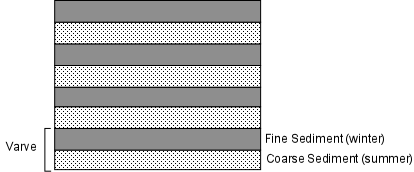
Rhythmic Layering - Alternating parallel layers having different properties. Sometimes caused by seasonal changes in deposition (Varves). i.e. lake deposits wherein coarse sediment is deposited in summer months and fine sediment is deposited in the winter when the surface of the lake is frozen.
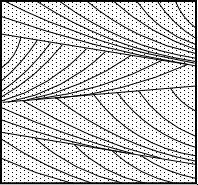
Cross Bedding - Sets of beds that are inclined relative to one another. The beds are inclined in the direction that the wind or water was moving at the time of deposition. Boundaries between sets of cross beds usually represent an erosional surface. Very common in beach deposits, sand dunes, and river deposited sediment.
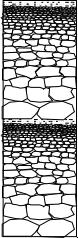
Graded Bedding - As current velocity decreases, first the larger or more dense particles are deposited followed by smaller particles. This results in bedding showing a decrease in grain size from the bottom of the bed to the top of the bed.
Non-sorted Sediment - Sediment showing a mixture of grain sizes results from such things as rockfalls, debris flows, mudflows, and deposition from melting ice.
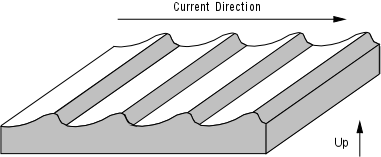
Ripple Marks - Characteristic of shallow water deposition. Caused by waves or winds
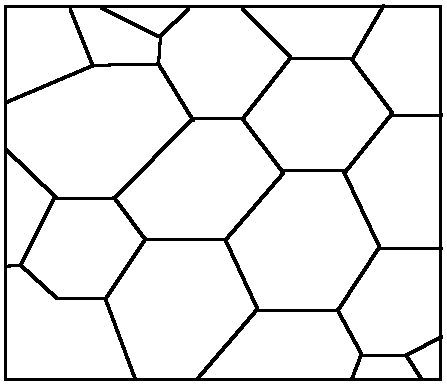
Mudcracks - result from the drying out of wet sediment at the surface of the Earth. The cracks form due to shrinkage of the sediment as it dries. Raindrop Marks- pits (or tiny craters) created by falling rain. If present, this suggests that the sediment was exposed to the surface of the Earth.
- Different species usually inhabit specific environments.
- Because life has evolved - fossils give clues to relative age of the sediment.
- Can also be important indicators of past climates.
- Iron oxides and sulfides along with buried organic matter give rocks a dark color. Indicates deposition in a reducing environment.
- Deposition in oxidizing environment produces red colored iron oxides.
Sedimentary Facies
A sedimentary facies is a group of characteristics which reflect a sedimentary environment different from those elsewhere in the same deposit. Thus, facies may change vertically through a sequence as a result of changing environments through time. Also, facies may change laterally through a deposit as a result of changing environments with distance at the same time.
Common Sedimentary Environments
- Non-marine environments
- Continental Shelf sediments
- Deltaic sediments
- Beach sediments
- Carbonate shelf sediments
- Marine evaporite sediments
- Deep Sea Fans
- Sediment drifts
- Land-derived sediments