Deserts and Winds


Deserts and Winds
back to Contents of Entire Course...
Wind as a Geologic Agent
Sediment Transportation by Wind
Wind Erosion
Wind Deposits:
Sand Dunes:
Deserts
Surface Processes in Deserts
Desertification
adapted to HTML from lecture notes of Prof. Stephen A. Nelson Tulane
University Wind as a Geologic Agent Wind is common in arid desert regions because:
- Air near the surface is heated and rises, cooler air comes in to replace hot rising air and this movement of air results in winds.
- Arid regions have little or no soil moisture to hold rock and mineral fragments.
- Wind has the ability to transport, erode, and deposit sediment.
Sediment Transportation by Wind
Wind transports sediment near the surface by saltation. Just as in the bed load of streams, saltation refers to short jumps of grains dislodged from the surface and jumping a short distance. As the grains fall back to the surface they may dislodge other grains that then get carried by wind until they collide with ground to dislodge other particles. Smaller particles can become suspended in the wind and may travel for longer distances.
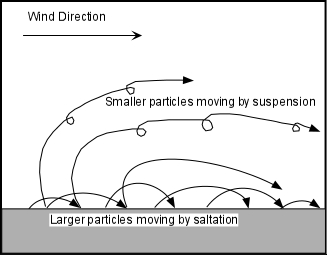
Sand Ripples - Occur as a result of larger grains accumulating as smaller grains are transported away. Ripples form in lines perpendicular to wind direction. Wind blown dust - Sand sized particles generally do not travel very far in the wind, but smaller sized fragments can be suspended in the wind for much larger distances.
Wind Erosion Wind
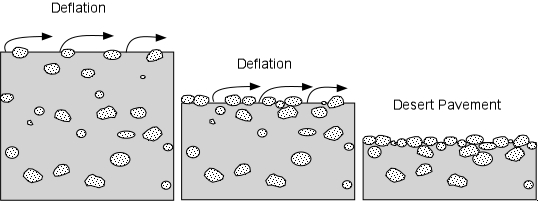
can be effective agent of erosion anywhere that it is strong enough to act. Wind can erode by deflation and abrasion. Deflation is the lowering of the land surface due to removal of fine-grained particles by the wind. Deflation concentrates the coarser grained particles at the surface, eventually resulting in a surface composed only of the coarser grained fragments that cannot be transported by the wind. Such a surface is called desert pavement
Ventifacts
Ventifacts are any bedrock surface or stone that has been abraded or
shaped by wind-blown sediment in a process similar to sand blasting.Yardangs
Yardangs are streamlined wind-eroded ridges commonly found in deserts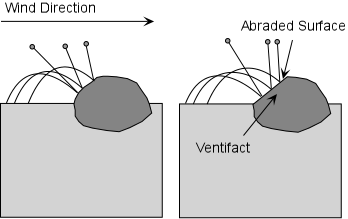
Wind Deposits
Wind can deposit sediment when its velocity decreases to the point where the particles can no longer be transported. This can happen when topographic barriers slow the wind velocity on the downwind side of the barrier. As the air moves over the top of the barrier, streamlines converge and the velocity increases. After passing over the barrier, the streamlines diverge and the velocity decreases. As the velocity decreases, some of the sediment in suspension can no longer be held in suspension, and thus drops out to form a deposit. Topographic barriers can be such things as rocks, vegetation, and human made structures that protrude above the land surface.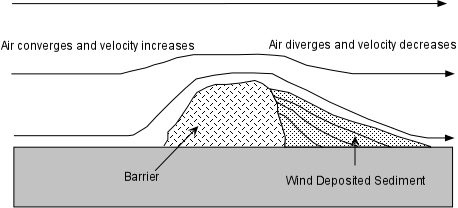
Sandunes
Sand Dunes - Sand dunes form when there is (1) a ready supply of sand, (2) a steady wind, and (3) some kind of obstacle such as vegetation, rocks, or fences, to trap some of the sand. Sand dunes form when moving air slows down on the downwind side of an obstacle. The sand grains drop out and form a mound that becomes a dune.
Sand dunes are asymmetrical mounds with a gentle slope in the upwind direction and steep slope called a slip face on the downwind side. Dunes migrate by erosion of sand by wind (saltation) on the gentle upwind slope, and deposition and sliding on the slip face, and thus are cross-bedded deposits.
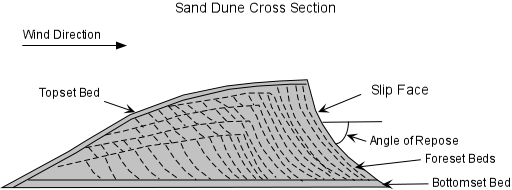
Dunes may cover large areas and reach heights up to 500m.
Barchan Dunes
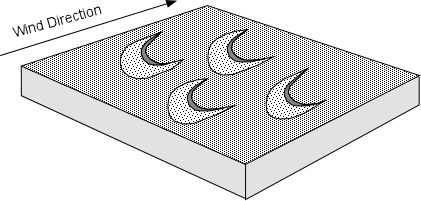
Barchan Dunes - are crescent-shaped dunes with the points of the crescents pointing in the downwind direction, and a curved slip face on the downwind side of the dune. They form in areas where there is a hard ground surface, a moderate supply of sand, and a constant wind direction.
Transverse Dunes
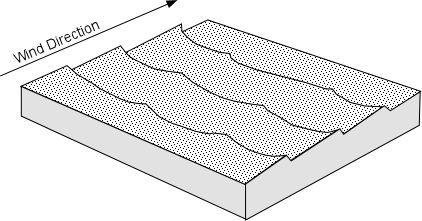
Transverse dunes - are large fields of dunes that resemble sand ripples on a large scale. They consist of ridges of sand with a steep face in the downwind side, and form in areas where there is abundant supply of sand and a constant wind direction. Barchan dunes merge into transverse dunes if the supply of sand increases.
Linear Dunes
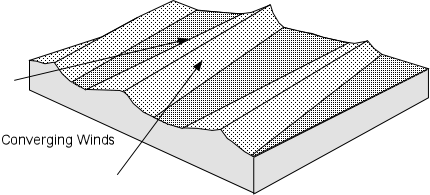
Linear Dunes - are long straight dunes that form in areas with a limited sand supply and converging wind directions.
Parabolic (Blowout) Dunes
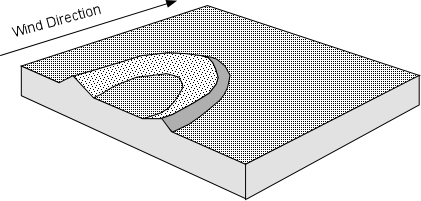
Parabolic (also called blowout) Dunes - are "U" shaped dunes with an open end facing upwind. They are usually stabilized by vegetation, and occur where there is abundant vegetation, a constant wind direction, and an abundant sand supply. They are common in coastal areas.
Star Dunes
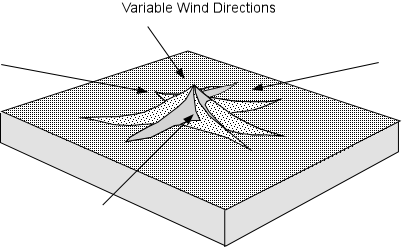
Star Dunes - are dunes with several arms and variable slip face directions that form in areas where there is abundant sand and variable wind directions.
- Wind Blown Dust - Dust consists of silt and clay sized particles that are often packed together with smooth surface. Such packed dust is difficult to remove by wind erosion alone, unless the surface is very dry or is disturbed. When dust it is disturbed, dust storms may develop, and dust may be transported by the wind over large distances. Most soil contains some silt and clay particles deposited by the wind. A large deposits of wind deposited dust is called loess. Much loess was derived from debris left by glacial erosion.
- Dust in Ocean Sediments and Glacial Ice. - Dust can be transported by the wind and by glacial ice onto the surface of the oceans. As a result, much of the fine grained continent-derived sediment that reaches the abyssal plains of the oceans was originally transported by winds or icebergs.
- Volcanic Ash - During explosive volcanic eruptions, large quantities of dust-sized tephra can be ejected into the atmosphere. If ejected high enough, such ash can become suspended in the wind and carried for long distances. Eventually it will settle out to become wind-deposited sediment.
Deserts
Deserts are areas where rainfall is less than 250 mm (10 in.)/year, or where evaporation exceeds precipitation. Thus, deserts are areas that we think of as arid. Origin of Deserts Deserts originate by several different mechanisms that result in several different types of deserts.
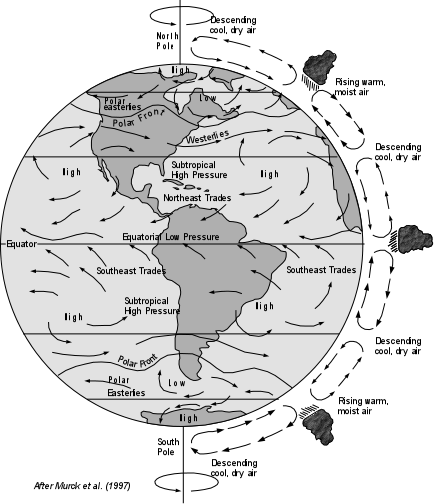
- Subtropical Deserts - the general atmospheric circulation brings
dry, subtropical air into mid-latitudes. Examples: Sahara of Northern
Africa, Kalhari of Southern Africa, and the Great Australian Desert.
Continental Deserts - Areas in the continental interiors, far from source of moisture where hot summers and cold winters prevail. Examples: Gobi, Takla Makan - Rainshadow Deserts - Areas where mountainous regions cause air to rise and condense, dropping its moisture as it passes over the mountains. Examples: Deserts east of the Sierra Nevada Mountains, California & Nevada, East of the Cascades of Oregon and Washington, and East of the Andes Mountains in South America.
- Coastal Deserts - Areas where cold upwelling seawater cools the air and decreases its ability to hold moisture. Examples : Atacama Desert of coastal Peru, Namib Desert of coastal South Africa.
- Polar Deserts - Cold polar regions where cold dry air prevails and moisture available remains frozen throughout the entire year. Examples: Northern Greenland, and ice-free areas of Antarctica.
Surface Processes
Surface Processes in Deserts The same geologic processes operate in deserts as in other more humid climates. The difference is the intensity to which the processes act.
- Weathering and Mass Wasting
- Deserts have little soil because moisture is so low and the rate of chemical weathering is slow.
- Little plant life because of lack of soils and water. Plants tend to hold soil and fine-grained rock fragments in place.
- The desert surface is dominated by mechanical weathering processes. If we compare the surface features of deserts with those in humid regions, we find that:
- deserts are dominated by rock falls, rock slides, and the accumulation of coarse grained material, and generally have steeper slopes.
- humid regions have soil and fine-grained regolith covering slopes, with creep being the dominant mass-wasting process, resulting in curved gentle slopes.
Streams and Fluvial Landforms
Surface Waters
Surface waters are rare in deserts. Streams that do flow in deserts usually originate at higher elevations and supply enough water for the stream to pass through the desert region. Streams in deserts tend to be intermittent, that is they flow only during rains. For this reason, flash floods and braided streams are common.
- Alluvial Fans and Bajadas - An alluvial fan forms where a mountain stream enters a broad flat valley and deposits sediment as its velocity decreases on entering the flatter valley (see chapter 9). When a linear mountain range has several closely spaced valleys, the alluvial fans may coalesce to form a gentle undulated slope on the sides of the bounding lowlands. Such coalesced alluvial fans are known as Bajadas.
- Pediments - A pediment is broad bedrock surface with a gentle slope away from highlands. With distance away from the highlands the pediment passes beneath a thin cover of alluvial sediment derived from erosion of the pediment. The highlands remain as residual hills as the pediment matures.
- Playa Lakes - Standing bodies of water like lakes are rare in desert regions because rainfall and input from streams occurs only intermittently. Lakes that do form during the rare periods of rainfall, quickly evaporate, leaving a dry lake bed behind. Playa Lakes (also called dry lakes) are formed in basins of internal drainage. The lake beds often consist of salts (evaporites) that were carried in by streams and precipitated during evaporation. These precipitated salts give the dry lake bed a white color resembling a beach (playa means beach in Spanish).
Inselbergs
Inselbergs - The word inselberg means island mountain in German. Inselbergs are steep sided hills that rise above a surrounding relatively flat plain. They appear to form because the rock making up the inselberg is more resistant to erosion than the rocks that once made up the surrounding plain. Once an inselberg forms, it sheds water due to its steep slopes, and its steep slopes tend to not develop soil. The surrounding less resistant rock collects this water and is subjected to more rapid rates of chemical weathering. Thus as the surrounding plain is reduced by stream erosion and weathering faster than the more resistant rock. Inselbergs are common in desert regions, although they can also occur in other areas where differential erosion takes place.
Desertification
Desertification Desertification occurs as a result of climatic changes, such as changing positions of the continents, or changes in ocean and air circulation patterns. Human impacts, such as overgrazing, draining of land, and lowering of the groundwater table, can also contribute to desertification. As vegetation dies out, the soil is more easily eroded and may be lost so that other vegetation becomes destabilized. Since soil can hold moisture, if the soil erodes, the area may become arid, and the desert expands.