Natural disasters - Earthquake Case History


Natural disasters - Earthquake Case History
based on lecture notes of Prof. Stephen A. Nelson, Tulane University
The 1994 Northridge Earthquake (magnitude 6.7), that occurred just north of Los Angeles in the San Fernando Valley.
The Northridge Earthquake did not occur along the San Andreas Fault, as most people assume, but instead occurred along a buried fault called a blind thrust fault, because it does not show up at the surface. A block diagram of a blind thrust fault is shown below.
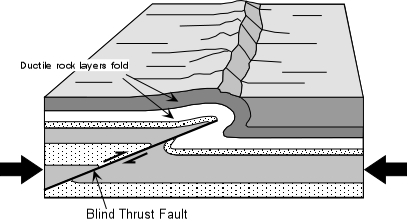
The Origin of Blind Thrust Faults
A blind thrust fault occurs in an area undergoing compressional stress that has rocks that deform in a ductile fashion overlying rocks that deform in a brittle fashion.
The compressional stress thus causes the upper rocks to fold as the hanging wall block is pushed up along the underlying thrust fault.
Blind thrust faults occur in southern California because of the nature of the strike-slip faulting that occurs on the San Andreas Fault. As seen in the diagram below, the San Andreas Fault is a right-lateral strike slip fault. To the southeast of Los Angeles, near Palm Springs, the San Andreas fault bends rather sharply to the west. Northwest of Los Angeles the fault bends back toward the northwest.
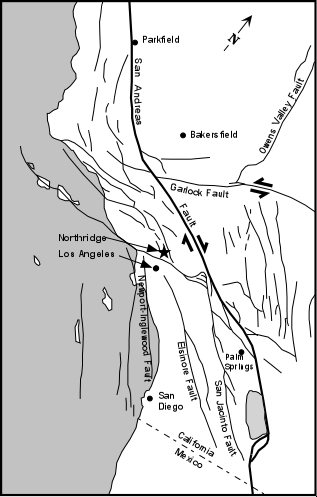
In this case the bend is called a left-stepping bend, because if we stand on the fault we see that it bends or turns to our left.
A left-stepping bend on a right-lateral strike-slip fault produces a zone of compression in a zone near the bend. Recall from our discussion of deformation of rocks, that compression results in reverse or thrust faults, if the rocks are brittle, and results in folding of the rock if the rocks are ductile.
Note that the opposite case of a right -stepping bend on a right-lateral strike-slip fault produces a zone of extension in the area of the bend.

Since the Los Angeles area is within the zone of compression, many of the east-west trending faults in the Los Angeles area are thrust faults, and there are likely more blind thrust faults that we don't know about that could potentially cause severe earthquakes in the future. In 1971 a magnitude 6.5 San Fernando Earthquake occurred on a thrust fault, however this fault is exposed at the surface, just to the east of the epicenter of the Northridge Earthquake.