Karsts in Australia


Karsts in Australia
Australia is well known as a dry continent; this reputation can be best demonstrated by the fact that two thirds of the continent has no runoff at all. One third has less than 250 mm of rainfall and the 750 mm isohyet is rarely more than 250 kilometres inland.
Much of the remainder is only seasonally or episodically moist and therefore karst processes can only operate for relatively short periods. The fact that many of the larger bodies of soluble rocks are found in the drier areas further reduces the opportunity for karst development. Even the well watered fringe is subject to extreme variability and the precipitation/evaporation ratio generally does not favour the ready availability of water.
The distribution of Australian karsts is shown this is about 4% of the continent and is an underestimate due to incomplete geological mapping. . It should be noted that a much larger area (around 15%) is underlain by limestone groundwater basins with a thick overburden of Quaternary deposits.
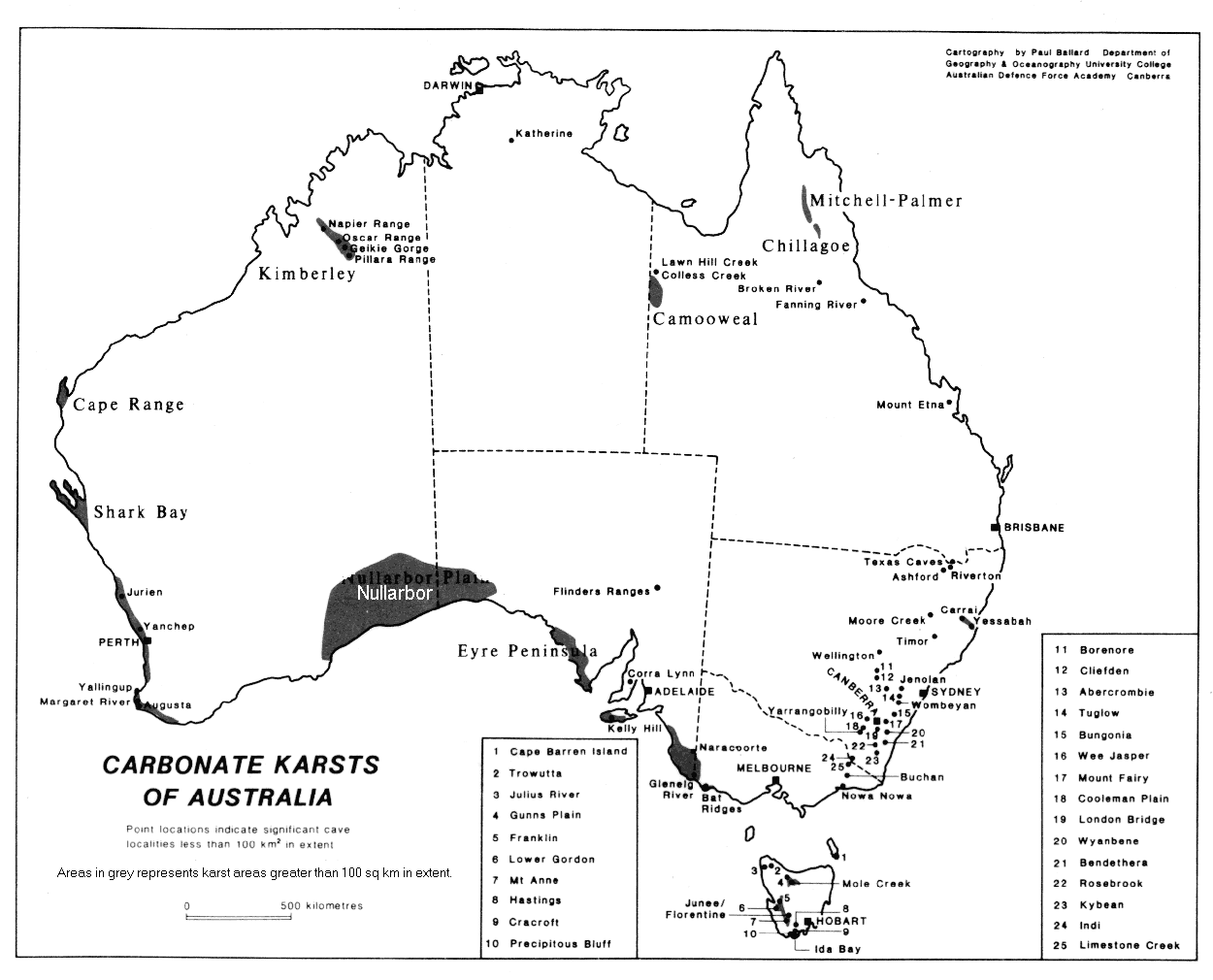
Climatic control of karst development can be seen dramatically in the difference between the dry Nullarbor Plain and the moist southeast of South Australia. Although the lithologies of the horizontally bedded, Tertiary limestones are very similar, the latter has extensive karstification in stark contrast to the Nullarbor.
This may in part be due to watertable change through tectonics as well as sea level fluctuations. Sea level changes have had an influence on the development of the Nullarbor caves but it may well be that the karst features of the Nullarbor are relics of former, more effective, precipitation regimes. There is, however, little evidence for this over the fifteen million years that the limestones have been above sea level.
In common with the other Gondwanaland continents Australia is poor in carbonate rocks. This is because much of the continent developed before carbonate rocks became an important proportion of the geological makeup of the earth. However, if the Precambrian shield area is ignored limestones and dolomite are present in relative abundance, but there is an extreme paucity of evaporite bedrocks in which karst features occur elsewhere in the globe. Australia is the only continent lacking Tertiary orogenic belts (excepting the Cape Range of W.A.); these usually contain extensive limestones and Australia misses out on this count as well. Illustration by M. Nyhof.)
Contact:- David Gillieson,
Senior Lecturer,
Dept. of Geography & Oceanography,
University College, University of New South Wales, Canberra, ACT 2601,
Australia.
Phone 61 6 2688305 Fax 61 6 2688313
email: d-gillieson@adfa.oz.au
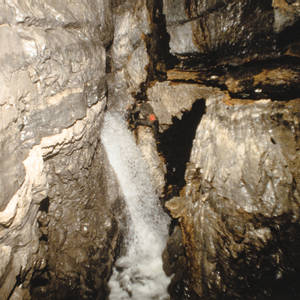
Karst is a distinctive topography in which the landscape is largely shaped by the dissolving action of water on carbonate bedrock (usually limestone, dolomite, or marble). This geological process, occurring over many thousands of years, results in unusual surface and subsurface features ranging from sinkholes, vertical shafts, disappearing streams, and springs, to complex underground drainage systems and caves. (Photo by J. Marc.)
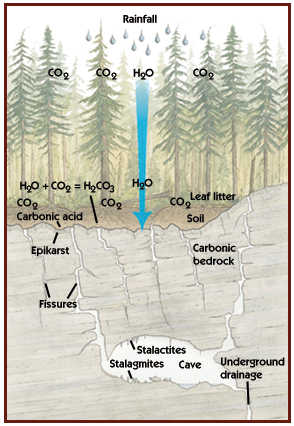
The process of karst formation involves what is referred to as "the carbon dioxide (CO2) cascade." As rain falls through the atmosphere, it picks up CO2 which dissolves in the droplets. Once the rain hits the ground, it percolates through the soil and picks up more CO2 to form a weak solution of carbonic acid:
H2O + CO2 = H2CO3
The infiltrating water naturally exploits any cracks or crevices in the rock. Over long periods, with a continuous supply of CO2-enriched water, carbonate bedrock begins to dissolve. Openings in the bedrock increase in size and an underground drainage system begins to develop, allowing more water to pass, further accelerating the formation of karst. Eventually this process leads to the development of subsurface caves.