Magmas, Igneous Rocks, Volcanoes and Plutons


Magmas, Igneous Rocks, Volcanoes, and Plutons
back to Contents of Entire Course...
Kinds of Igneous Rock
Types of Magma
Eruption of Magma
Origin of Magma
Origin of Basaltic Magma
Origin of Granitic Magma
Origin of Andesitic Magma
Magmatic Differentiation
Bowen's Reaction Series
Volcanoes and Volcanic Rocks
Plutons adapted to HTML from lecture notes
of Prof. Stephen A. Nelson Tulane University
Kinds of Igneous Rock
Igneous Rocks are formed by crystallization from a liquid, or magma. They include two types:
Magma is a mixture of liquid rock, crystals, and gas. Characterized
by a wide range of chemical compositions, with high temperature,
and properties of a liquid.
Magmas are less dense than surrounding rocks, and will therefore move upward. If magma makes it to the surface it will erupt and later crystallize to form an extrusive or volcanic rock. If it crystallizes before it reaches the surface it will form an igneous rock at depth called a plutonic or intrusive igneous rock. Because cooling of the magma takes place at a different rate, the crystals that form and their interrelationship (texture) exhibit different properties.

Fast cooling on the surface results in many small crystals or quenching to a glass. Gives rise to aphanitic texture (crystals cannot be distinguished with the naked eye), or obsidian (volcanic glass).
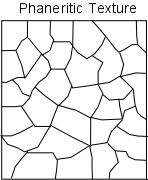
Slow cooling at depth in the earth results in fewer much larger crystals , gives rise to phaneritic texture.
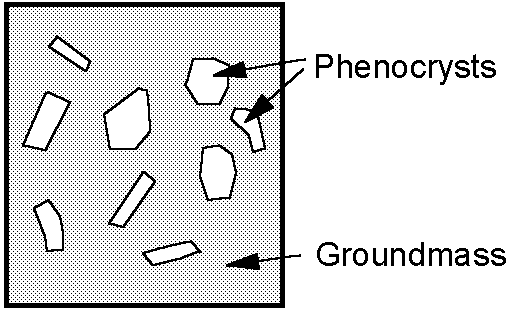
Porhpyritic texture develops when slow cooling is followed by rapid cooling.
Phenocrysts = larger crystals, matrix or groundmass = smaller crystals.
Other rock textural terms
Types of Magma
Chemical composition of magma is controlled by the abundance of elements in the earth. Si, Al, Fe, Ca, Mg, K, Na, H, and O make up 99.9%. Since oxygen is so abundant, chemical analyses are usually given in terms of oxides. SiO2 is the most abundant oxide.
- Basaltic or gabbroic -- SiO2 45-55 wt%, high in Fe, Mg, Ca, low in K, Na
- Andesitic or Dioritic -- SiO2 55-65 wt%, intermediate. in Fe, Mg, Ca, Na, K
- Rhyolitic or Granitic -- SiO2 65-75%, low in Fe, Mg, Ca, high in K, Na.
- Higher SiO2 content magmas have higher viscosity than lower SiO2 content magmas
- Lower Temperature magmas have higher viscosity than higher temperature magmas.
- Mostly H2O with some CO2
- Minor amounts of Sulfur, Cl , and F
- Rhyolitic or granitic magmas usually have higher gas contents than basaltic or gabbroic magmas.
Temperature of Magmas
- Basaltic or gabbroic - 1000-1200oC
- Andesitic or dioritic - 800-1000oC
- Rhyolitic or granitic - 650-800oC.
Viscosity of Magmas - Viscosity is the resistance to flow (opposite of fluidity) Depends on composition, temperature, gas content.
- Higher SiO2 content magmas have higher viscosity than lower SiO2 content magmas
- Lower Temperature magmas have higher viscosity than higher temperature magmas.
| Summary Table | ||||||
|---|---|---|---|---|---|---|
| Magma Type | Solidified Volcanic Rock | Solidified Plutonic Rock | Chemical Composition | Temperature | Viscosity | Gas Content |
| Basaltic | Basalt | Gabbro | 45-55 SiO2 %, high in Fe, Mg, Ca, low in K, Na | 1000 - 1200 oC | Low | Low |
| Andesitic | Andesite | Diorite | 55-65 SiO2 %, intermediate in Fe, Mg, Ca, Na, K | 800 - 1000 oC | Intermediate | Intermediate |
| Rhyolitic | Rhyolite | Granite | 65-75 SiO2 %, low in Fe, Mg, Ca, high in K, Na | 650 - 800 oC | High | High |
Eruption of Magma
When magmas reach the surface of the Earth they erupt from a vent.
- They may erupt explosively or non explosively.
- Non explosive eruptions are favored by low gas content and low viscosity magmas (basaltic to andesitic magmas).
- Usually begin with fire fountains due to release of dissolved gases
- Produce lava flows on surface
- Produce Pillow lavas if erupted beneath water
- Explosive eruptions are favored by high gas content and high viscosity (andesitic to rhyolitic magmas).
- Expansion of gas bubbles is resisted by high viscosity of magma - results in building of pressure
- High pressure in gas bubbles causes the bubbles to burst when reaching the low pressure at the Earth's surface.
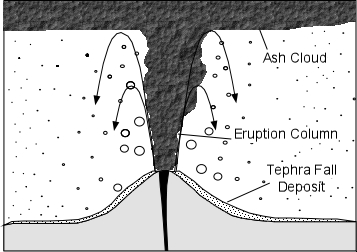
- Bursting of bubbles fragments the magma into pyroclasts and tephra (ash).
- Cloud of gas and tephra rises above volcano to produce an eruption column that can rise up to 45 km into the atmosphere.
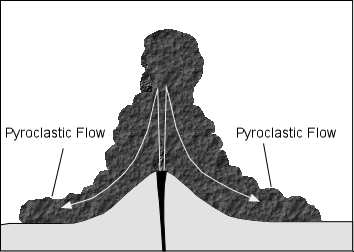
If eruption column collapses a pyroclastic flow may occur, wherein gas and tephra rush down the flanks of the volcano at high speed. This is the most dangerous type of volcanic eruption. The deposits that are produced arecalled ignimbrites.
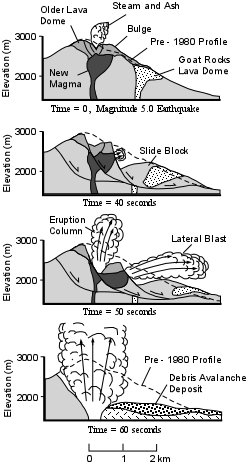
Lateral blasts and debris avalanches occur when gas is released suddenly by a large landslide or debris avalanche taking out part of the volcano
Origin of Magma
In order for magmas to form, some part of the earth must get hot enough to melt the rocks present. Under normal conditions, the geothermal gradient is not high enough to melt rocks, and thus with the exception of the outer core, most of the Earth is solid. Thus, magmas form only under special circumstances. To understand this we must first look at how rocks and mineral melt.
As pressure increases in the Earth, the melting temperature changes as well. For pure minerals, there are two general cases.
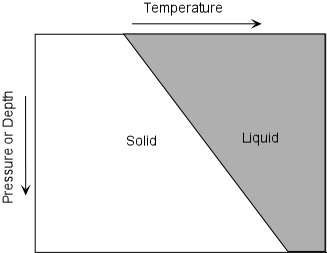
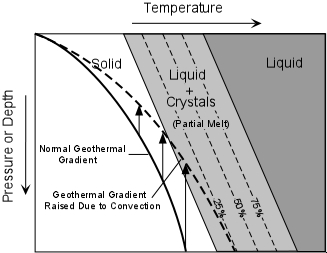
For a pure dry (no H2O or CO2 present) mineral, the melting temperate increases with increasing pressure.
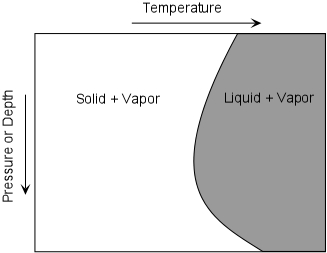
For a mineral with H2O or CO2 present, the melting temperature first decreases with increasing pressure
Since rocks mixtures of minerals, they behave somewhat differently. Unlike minerals, rocks do not melt at a single temperature, but instead melt over a range of temperatures. Thus it is possible to have partial melts, from which the liquid portion might be extracted to form magma. The two general cases are:

Melting of dry rocks is similar to melting of dry minerals, melting temperatures increase with increasing pressure, except there is a range of temperature over which there exists a partial melt. The degree of partial melting can range from 0 to 100%
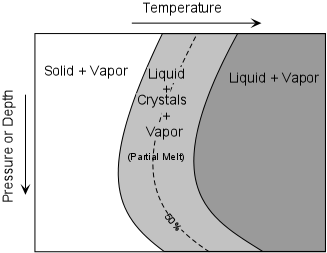
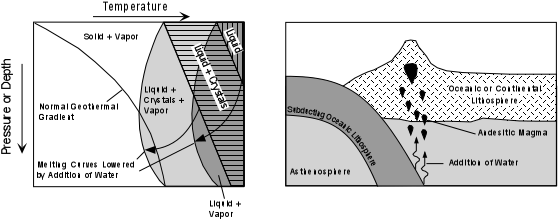
Melting of rocks containing water or carbon dioxide is similar to melting of wet minerals, melting temperatures initially decrease with increasing pressure, except there is a range of temperature over which there exists a partial melt.
Origin of Basaltic Magma
Much evidence suggests that Basaltic magmas result from dry partial melting of mantle.

- Basalts make up most of oceanic crust and only mantle underlies crust.
- Basalts contain minerals like olivine, pyroxene and plagioclase, none of which contain water.
- Basalts erupt non-explosively, indicating a low gas content and therefore low water content.
The Mantle is made of garnet peridotite (a rock made up of olivine, pyroxene, and garnet) -- evidence comes from pieces brought up by erupting volcanoes. In the laboratory we can determine the melting behavior of garnet peridotite.

Under normal conditions the temperature in the Earth, shown by the geothermal gradient, is lower than the beginning of melting of the mantle. Thus in order for the mantle to melt there has to be a mechanism to raise the geothermal gradient. Once such mechanism is convection, wherein hot mantle material rises to lower pressure or depth, carrying its heat with it. If the raised geothermal gradient becomes higher than the initial melting temperature at any pressure, then a partial melt will form. Liquid from this partial melt can be separated from the remaining crystals because, in general, liquids have a lower density than solids. Basaltic or gabbroic magmas appear to originate in this way.
Origin of Granitic
Magma

Most Granitic or Rhyolitic magma appears to result from wet melting of continental crust. The evidence for this is:
Solidified granite or rhyolite contains quartz, feldspar, hornblende, biotite, and muscovite. The latter minerals contain water, indicating high water content
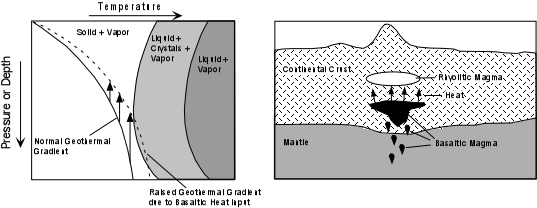
Still, the temperature in continental crust is usually not high enough to cause melting, and thus another heat source is necessary. In most cases it appears that this heat source is basaltic magma. The basaltic magma is generated in the mantle, then rises into the continental crust. But, because basaltic magma has a high density it may stop in the crust and crystallize, releasing heat into the surrounding crust. This raises the geothermal gradient and may cause wet partial melting of the crust to produce rhyolitic magmas.
Origin of Andesitic Magma
Average composition of continental crust is andesitic, but if andesite magma is produced by melting of continental crust then it requires complete melting of crust. Temperatures in crust unlikely to get high enough. Andesitic magmas erupt in areas above subduction zones - suggests relation between production of andesite and subduction. One theory involves wet partial melting of subducted oceanic crust. But, newer theories suggest wet partial melting of mantle.

Magmatic Differentiation
When magma solidifies to form a rock it does so over a range of temperature. Each mineral begins to crystallize at a different temperature, and if these minerals are somehow removed from the liquid, the liquid composition will change. Depending on how many minerals are lost in this fashion, a wide range of compositions can be made. The processes is called magmatic differentiation by crystal fractionation. Crystals can be removed by a variety of processes. If the crystals are more dense than the liquid, they may sink. If they are less dense than the liquid they will float. If liquid is squeezed out by pressure, then crystals will be left behind. Removal of crystals can thus change the composition of the liquid portion of the magma. Let me illustrate this using a very simple case. Imagine a liquid containing 5 molecules of MgO and 5 molecules of SiO2. Initially the composition of this magma is expressed as 50% SiO2 and 50% MgO. i.e

Now let's imagine I remove 1 MgO molecule by putting it into a crystal and removing the crystal from the magma. Now what are the percentages of each molecule in the liquid?

If we continue the process one more time by removing one more MgO molecule

Thus, composition of liquid can be changed.
Bowen's Reaction Series
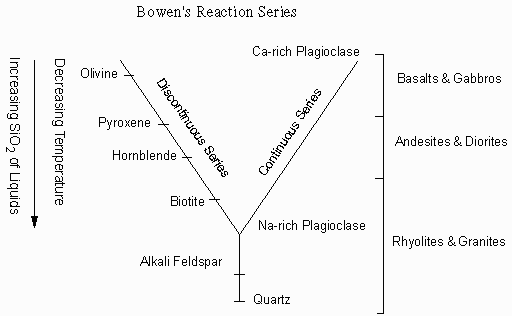
Bowen found by experiment that the order in which minerals crystallize from a basaltic magma depends on temperature. As a basaltic magma is cooled Olivine and Ca-rich plagioclase crystallize first. Upon further cooling, Olivine reacts with the liquid to produce pyroxene and Ca-rich plagioclase react with the liquid to produce less Ca-rich plagioclase. But, if the olivine and Ca-rich plagioclase are removed from the liquid by crystal fractionation, then the remaining liquid will be more SiO2 rich. If the process continues, an original basaltic magma can change to first and andesite magma then a rhyolite magma with falling temperature
Volcanoes and Volcanic
Rocks
Basalts, Andesites, Dacites and Rhyolites are all types of volcanic rock distinguished on the basis of their mineral assemblage. Depending on conditions present during eruption and cooling, any of these rock types may form one of the following types of volcanic rocks.
- Obsidian - dark colored volcanic glass showing concoidal fracture. Usually rhyolitic or dacitic.
- Pumice - light colored and light weight rock consisting of mostly holes (vesicles) that were once occupied by gas, Usually rhyolitic, dacitic or andesitic.
- Vesicular rock - rock filled with holes (Swiss cheese) or vesicles that were once occupied by gas. Usually basaltic and andesitic.
- Amygdaloidal basalt. If vesicles in a vesicular basalt are later filled by precipitation of calcite or quartz, the fillings are termed amygdules and the basalt is termed an amygdaloidal basalt.
- Pyroclasts and Tephra Pyroclasts = hot, broken fragments. Result from explosively ripping apart of magma. Loose assemblages of pyroclasts called tephra. Depending on size, tephra can be classified as bombs. lapilli, or ash.
- Rock formed by accumulation and cementation of tephra called a pyroclastic rock or tuff. Welding, compaction and deposition of other grains cause tephra (loose material) to be converted in pyroclastic rock.
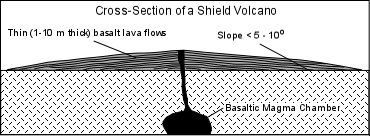
Shield volcano - volcanoes that erupt low viscosity magma (usually basaltic) that flows long distances from the vent.
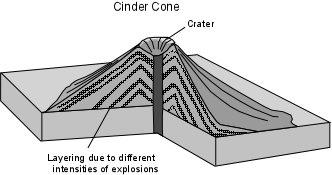
Pyroclastic cone or cinder cone - a volcano built mainly of tephra fall deposits located immediately around the vent.

Stratovolcano (composite volcano) - a volcano built of interbedded lava flows and pyroclastic material.
Crater - a depression caused by explosive ejection of magma or gas.
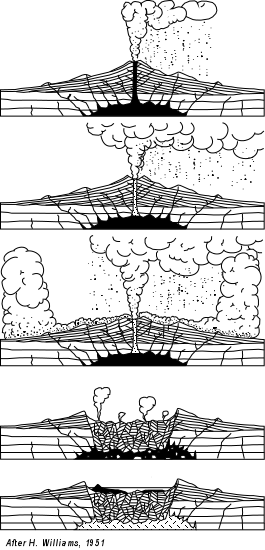
Caldera - a depression caused by collapse of a volcano into the cavity once occupied by magma
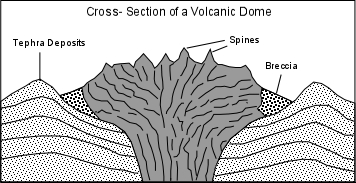
Lava Dome - a steep sided volcanic structure resulting from the eruption of high viscosity, low gas content magma
Thermal Springs and Geysers - hot water resulting from heating by magma at depth in the Earth. Springs flow, geysers erupt.
Fissure Eruptions - An eruption that occurs along a narrow crack or fissure in the Earth's surface.
Pillow Lava - Lavas formed by eruption beneath the surface of the ocean or a lake.
Plutons

Igneous rocks cooled at depth. Name comes from Greek god of the underworld - Pluto.
- Dikes - a small tabular intrusion that cuts across layers of pre-existing rock.
- Sills - a tabular intrusion that intruded parallel to layers of pre-existing rock.
- Lacoliths - similar to a sill, except the layers above are bent upward by the intrusion.
- Volcanic Necks - a former volcanic conduit that has been exposed by erosion of the volcano.
- Batholiths - a large intrusion usually of granitic or dioritic composition.
- Stocks - a somewhat smaller intrusion usually intruded off of a larger batholith.
Methods of intrusion
- Melting - crystallization
- Stoping - xenoliths
- Injection
Answer - They are exposed by erosion which has removed all of the material above the intrusion