Global Change

Global Change
Contents of Entire Course
Solar Radiation and the Atmosphere
Ozone (O3)
Greenhouse Gases
Volcanic Effects
Carbon Dioxide in the Atmosphere
Methane
The Carbon Cycle
Global Warming
Effects of Global Warming
Global Warming in the Past
Mid-Cretaceous
Eocene
adapted to HTML from lecture notes of Prof. Stephen A. Nelson Tulane University
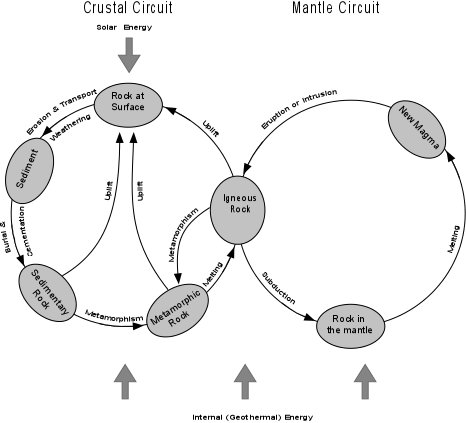
The Earth is a complex system. Changes that take place in one part of the system have effects on other parts. The tectonic system is driven by the heat in the Earth. This drives the rock cycle, which is also affected by the atmosphere and biosphere. The atmosphere is in chemical equilibrium with the oceans and exchanges matter with the biosphere. All process act on a variety of time scales from hundreds of millions of years to microseconds. We as human beings are only now realizing that, as part of the biosphere, we have an effect on the Earth.
One of the reasons life exists on Earth is that the surface has a controlled temperature in the range between the freezing and boiling points of water. The Earth is the only planet in the solar system where this is true. Part of the reason for this results from the distance from the Sun. But, the reason that temperature remains fixed is controlled by the atmosphere.
Solar Radiation and the Atmosphere
Radiation reaching the Earth from the Sun is electromagnetic radiation. Electromagnetic radiation can be divided into different regions depending on wavelength. Note that visible light is the part of the electromagnetic spectrum to which human eyes are sensitive.
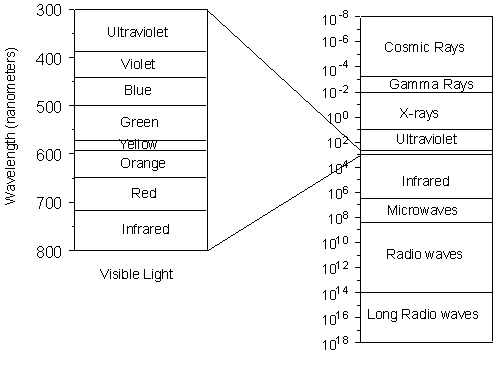
Earth receives all wavelengths of solar radiation. But certain gases and other contaminants in the atmosphere have different effects on different wavelengths of radiation.
Dry air is composed of about 79% Nitrogen, 20% oxygen, and 1% Argon. It also contains water, 4% at saturation, but saturation depends on temperature.
In addition trace gases have an effect. Among the trace gases are:
Ozone (O3)
Ozone is produced in the upper atmosphere (30 - 35 km above surface) by incoming ultraviolet radiation. Ultraviolet radiation causes O2 to go to O + O. Some of the O then recombines with O2 to make O3. This ozone then absorbs more ultraviolet radiation and breaks down to O2 + O. The process is self regulating and results in less ultraviolet radiation reaching the Earth's surface. Ultraviolet radiation is harmful to organisms because it is high energy radiation that damages cells. In humans, excessive exposure to ultraviolet light causes sunburns and skin cancer. The Effect of Chlorofluorocarbons (CFCs)(animation) in the atmosphere.
CFCs are produced to make refrigerants and styrofoam. Chlorine from these human made products enters the atmosphere and catalyzes the breakdown of ozone. Cl combines with ozone to make ClO and O2. Ultraviolet radiation then causes ClO to react with O to make Cl and O2. This Cl can then react with Ozone, and the process repeats. It is estimated that for every Cl molecule in atmosphere, 100,000 ozone molecules can be destroyed. It has been observed that the protecting ozone layer in the upper atmosphere has deteriorated over the last 50 years, a result thought to be produced by human introduction of CFCs into the atmosphere.
Greenhouse Gases
Infrared radiation carries most of the heat from the Sun to the Earth. Greenhouse gases scatter both the incoming infrared radiation as well as infrared radiation reflected from the Earth's surface. Shorter wave length radiation that makes it to the Earth's surface where it is converted to heat in the form of infrared radiation. The greenhouse gases then scatter this radiation with about half of it being scattered back into the atmosphere. This keeps the atmospheric temperature relatively stable, so long as the concentration of greenhouse gases remains relatively stable.The most important green house gases are H2O (water vapor), CO2 (Carbon Dioxide), and CH4 (methane). H2O is the most abundant greenhouse gas, but its concentration in the atmosphere varies with temperature. Venus, which has mostly CO2 in its atmosphere, has temperature of about 500oC (also partly due to nearness to Sun)
Volcanic Effects
Volcanoes produce several things that result in changing atmosphere and atmospheric temperatures.
- CO2 produced by volcanoes adds to the greenhouse gases and may result in warming of the atmosphere.
- Sulfur gases produced by volcanoes reflect low wavelength radiation back into space, and thus result in cooling of the atmosphere.
- Dust particles injected into the atmosphere by volcanoes reflect low wavelength radiation back into space, and thus can result in cooling of the atmosphere.
- Chlorine gases produced by volcanoes can contribute to ozone depletion in the upper atmosphere.
The Mt. Pinatubo eruption in 1991 and El Chichon eruption in 1981 released large quantities of dust and sulfur gases - resulted in short term cooling of atmosphere.
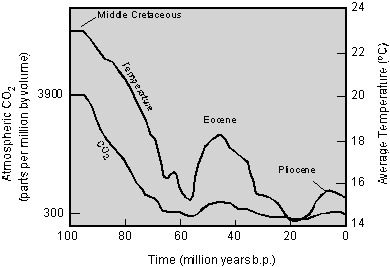
Volcanism in the middle Cretaceous produced large quantities of basalt on the seafloor and released large amounts of CO2. The middle Cretaceous was much warmer than present, resulting in much higher sea level
Carbon Dioxide in the Atmosphere
CO2 of atmosphere has been increasing since the mid 1800s. Correlates well with burning of fossil fuels. Thus humans appear to have an effect.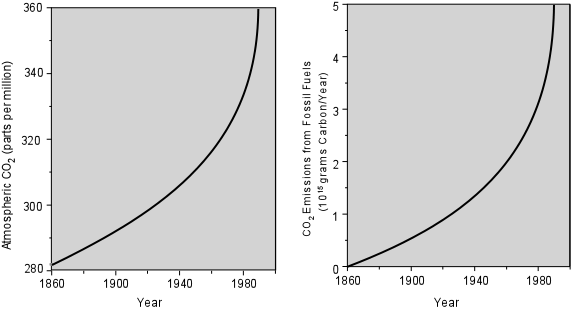
Methane
Methane concentration in the atmosphere has also been increasing. Naturally this occurs due to decay of organic matter, the digestive processes of organisms, and leaks from petroleum reservoirs. Man has contributed through domestication of animals, increased production of rice, and leaks from gas pipelines and petrol.
The Carbon Cycle
In order to understand whether or not humans are having an effect on atmospheric carbon concentrations, we must look at how carbon moves through the environment. Carbon is stored in four main reservoirs.
- In the atmosphere as CO2 gas. From here it exchanges with seawater or water in the atmosphere to return to the oceans, or exchanges with the biosphere by photosynthesis, where it is extracted from the atmosphere by plants. CO2 returns to the atmosphere by respiration from living organisms, from decay of dead organisms, from weathering of rocks, from leakage of petroleum reservoirs, and from burning of fossil fuels by humans.
- In the hydrosphere (oceans and surface waters) as dissolved CO2. From here it precipitates to form chemical sedimentary rocks, or is taken up by organisms to enter the biosphere. CO2 returns to the hydrosphere by dissolution of carbonate minerals in rocks and shells, by respiration of living organisms, by reaction with the atmosphere, and by input from streams and groundwater.
- In the biosphere where it occurs as organic compounds in organisms. CO2 enters the biosphere mainly through photosynthesis. From organisms it can return to the atmosphere by respiration and by decay when organisms die, or it can become buried in the Earth.
Cycling between the atmosphere and the biosphere occurs about every 4.5 years. Cycling between the other reservoirs probably occurs on an average of millions of years.
For example, carbon stored in the Earth in sedimentary rocks or as fossil fuels only re-enters the atmosphere naturally when weathering and erosion expose these materials to the Earth's surface. When humans extract and burn fossil fuels the process occurs much more rapidly than it would occur by natural processes. With an increased rate of cycling between the Earth and the atmosphere, extraction from the atmosphere by increased interaction with the oceans, or by increased extraction by organisms must occur to balance the input. If this does not occur, it may result in global warming.
Global Warming
Average global temperatures vary with time as a result of many processes interacting with each other. These interactions and the resulting variation in temperature can occur on a variety of time scales ranging from yearly cycles to cycles with times measured in millions of years. Such variation in global temperatures is difficult to understand because of the complexity of the interactions and because accurate records of global temperature do not go back more than 100 years. But, even if we look at the record for the past 100 years, we see that overall, there is an increase in average global temperatures, with minor setbacks that may have been controlled by random events such as volcanic eruptions or El Niño events. Records for the past 100 years indicate that average global temperatures have increased by about 0.5oC. While this may not seem like much, the difference in global temperature between the coldest period of the last glaciation and the present was only about 5oCIn order to predict future temperature changes we first need to understand what has caused past temperature changes. Computer models, called Global Circulation Models have been constructed to attempt this. Although there is still much uncertainty, most of these models agree that if the greenhouse gases continue to accumulate in the atmosphere until they have doubled over their pre-1860 values, the average global temperature increase will be between 1 and 5oC. This is not a uniform temperature increase. Most models show that the effect will be greatest at high latitudes (near the poles) where yearly temperatures could be as much as 16oC warmer than present.
Again, because of the large number of uncertainties involved in the computer models scientists are reluctant to rely on the models. Still, there is a consensus that average temperatures have increased over the last 100 years, and that if these increases are due to the added input of greenhouse gases into the atmosphere, then temperatures will continue to increase at a rate of about 0.3oC per decade. This will lead to average temperatures about 1 degree warmer by the year 2025 and about 3 degrees warmer by the year 2100.
Effects of Global warming
- Global Precipitation changes - A warmer atmosphere will lead to increased evaporation from surface waters and result in higher amounts of precipitation. The equatorial regions will be wetter than present, while the interior portions of continents will become warmer and drier than present.
- Changes in vegetation patterns - because rainfall will distributed differently, vegetation will have to adjust to the new conditions. Mid latitude regions are likely to be more drought prone, while higher latitude regions will be somewhat wetter and warmer than normal, resulting in a shift in agricultural patterns.
- Increased storminess - A warmer, wetter atmosphere will favor tropical storm development. Hurricanes will be stronger and more frequent.
- Changes in Ice patterns. - Due to higher temperatures, ice in mountain glaciers will melt. But, because more water will be evaporated from the oceans, more precipitation will reach the polar ice sheets causing them to grow.
- Reduction of sea ice - Sea ice will be greatly reduced to the increased temperatures at the high latitudes, particularly in the northern hemisphere where there is more abundant sea ice. Ice has a high albedo (reflectivity), and thus reduction of ice will reduce the albedo of the Earth and less solar radiation will be reflected back into space, thus enhancing the warming effect.
- Thawing of frozen ground - Currently much of the ground at high latitudes remains frozen all year. Increased temperatures will cause much of this ground to thaw. Organic compounds and gas hydrates in the frozen ground will be subject to decay, releasing more methane into the atmosphere and enhancing the greenhouse effect. Ecosystems and human structures currently built on frozen ground will have to adjust.
- Changes in the hydrologic cycle - With new patterns of precipitation changes in stream flow and groundwater level will be expected.
- Decomposition of organic matter in soil - With increasing temperatures of the atmosphere the rate of decay of organic material in soils will be greatly accelerated. This will result in release of CO2 and methane into the atmosphere and enhance the greenhouse effect
Global Warming in the Past
From out study of glaciations in the past we know that climate can change as result of natural processes, both becoming warmer and colder than present. Although these climatic fluctuations appear to be caused by eccentricities in the Earth's orbit, it is interesting to note that during glaciations in the past the concentrations of greenhouse gas concentrations in the atmosphere were lower, atmospheric dust was higher, and the Earth's albedo was higher, all of these factors could have contributed to cooler climates. Similarly, during past interglacial episodes, the atmosphere contained less dust, higher concentrations of greenhouse gases, and the Earth had a lower albedo, all of which contribute to warmer climates. The questions that remain to be answered are:
- Are there higher concentrations of greenhouse gases and lower dust concentrations in the atmosphere due to the warmer temperatures or did they cause the warmer temperatures?
- Are these differences simply due to orbital variations, or is there some other natural self regulating process that allows for cycles?
- How do human affect these cycles?
Mid-Cretaceous
During this period we note the following observations:
The rate of production of new oceanic crust between 120 and 90 million years ago (mid Cretaceous) were nearly twice the rate prior to and after that time.
- Large volcanic plateaus were emplaced in the ocean basins. The total volume of these eruptions of basalt are unknown, as some may have been subducted, but many are greater than 10 million km3. (The Ontong Java plateau of the southwestern Pacific alone has a volume of ~ 55 million km3.
- The time interval during which these volcanic plateaus were emplaced correlate with:
- A long interval of normal magnetic polarity.
- A peak in oceanic paleotemperatures.
- A peak in world-wide formation of petroleum.
- Deposition of oxygen depleted sediments like black shales.
- A peak in sea level stands, which became 100 to 200 m higher than present.
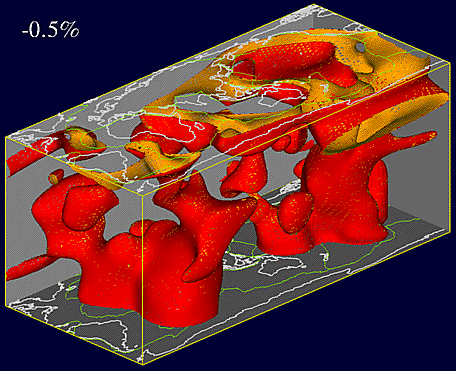
- CO2 released from the magmas erupted on the ocean floor by these plumes resulted in a super green house effect, causing mid Cretaceous climates to increase to 10 to 12o C above current average global temperatures.
- Increased ocean temperatures resulted in an increase in productivity of marine life which resulted in the formation of increased formation of petroleum.
- Increased global temperatures resulted in sluggish circulation of ocean water which resulted in oxygen depleted waters and the deposition of Carbon rich black shales. These shales were preserved because shallow seas flooding the continents.
- The large volume of basalts erupted on the ocean floor displaced sea water resulting higher stands of the sea.
Eocene Global Warming
During this period we note the following:
- Fossils of alligators are found on Elsmere Island at 78o North Latitude
- Tropical vegetation and tropical marine organism fossils occur up to 45 to 55o North and South Latitude, about 15o higher than today.
- Estimates of atmospheric CO2 concentrations show values between 2 and 6 times current values.
The increased CO2 concentrations have been attributed to a large scale metamorphic event that occurred as a result of the continent-continent collision that began to uplift the Himalayas, and other metamorphic events that occurred in the Mediterranean region and the circum-Pacific region during the Eocene. Such metamorphic events, particularly in the upper parts of the metamorphic areas where greenschist metamorphism would occur, would release large amounts of CO2 into the atmosphere.
This example shows how the rock cycle itself, aided by tectonic processes could affect atmospheric conditions
Hopefully this will give you an idea about how human beings can effect the way the Earth works, and also give you an idea about the complexity of the interactions between various parts of the Earth and processes that occur throughout the Earth.
Unfortunately, the complexity of the processes are not completely understood. This has major political implications. For example, scientists are uncertain about the reliability of models that attempt to predict future conditions. This uncertainty is taken by some political factions as a denial that an event like global warming will take place. Most scientists, however, agree that global warming is highly possible, but they are unwilling to say that it will definitely occur. Politicians want, or expect you to want, exact answers. The real question, however, is whether or not we should be preparing for such events to avoid disaster if it does occur, or, since we can't be certain, just wait until the disaster has occurred and we can do nothing about it.