Alternative Energy


Alternative Energy
go back to Contents of Entire Course...
Solar
Energy
GeoThermal Energy
Hydro Energy
Tidal Power
Wind Energy
Biomass
Biogas
The Atmosphere
Focus in the Future
External Links
adapted to HTML from lecture notes of Prof. Stephen A. Nelson Tulane
University Solar Energy
- Potentially can supply 10% to 15% of our energy needs.
- Can get electricity from the sun the following ways
- Passive
- Active
- Photo-electric (photo-voltaic)
- Passive
- This type of solar heating takes advantage of the greenhouse effect. Sunlight comes into a room through glass walls and ceiling. This energy is converted into heat, which is then trapped in the walls, or else used to heat water tanks which can then act as thermal reservoirs. At night these reservoirs continue to heat the home.
- Active
- This type of system uses solar panels mounted on a roof. These solar panels have water running through them. The water is heated and then goes into the home where it can be used to heat water or the home.
- Photovoltaic cells
- In this type of a system thin wafers of purified silicon which have trace amounts of gallium and cadmium are exposed to light. This light causes electrons to be emitted which creates a electrical current. Some hand held calculators take advantage of this system. The problem with this energy source is currently it is more expensive than traditional energy sources. The good news is the price is dropping rapidly. In 1980 it cost about 90 cents/kwatt. Currently the cost is down to 12 cents/kwatt.

GeoThermal Energy
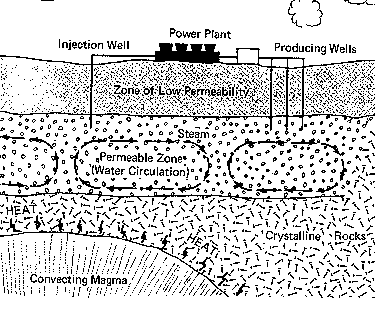
- This type of energy source takes advantage of water which is heated by magma lying close to the earth's surface.
- This type of energy is limited to a few areas of the west in the U.S. and is non-renewable.
- Potential of less then 10%.
- In this type of a system steam is used to run the turbines which create electricity. The magma is probably around 2,000° F. This system will probably only last 10's of years before the rocks have been cooled.
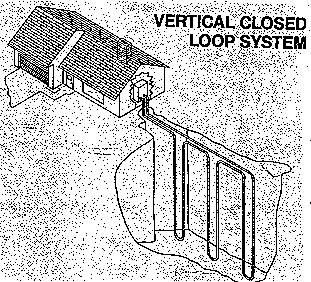
- Although the aforementioned geothermal system has very limited use there is another system that could take advantage of water in the earth. About 10 feet below ground the earth is unaffected by seasonal changes and keeps a constant temperature of about 52 deg F on Long Island. A vertical closed loop system which had pipes filled with water going down into the ground until heated to 52 deg F and then brought back out into a home could be used as a heating system in the winter, and a cooling system in the summer. The water temperature would be perfect for air conditioning in the summer.Water being heated in the winter would require considerably less energy to raise it from the 52 deg F then would much colder air in the winter months.
Hydro Energy
- Currently provides 15% of our energy.
- Can potentially provide 30 to 50% of our energy needs.
- The large rivers are already well used so you would have to dam smaller streams.
- There are several environmental problems associated with hydropower:
- Kills off fish or prevents migration.
- Dams trap sediment
- Dams turn wild rivers into a series of lakes.
- Dams may burst, killing thousands of people downstream.
- Currently 0 to low %.
- At the moment, requires atleast 25 foot tides.
- In some confined estuaries and bays the difference in water height
between low and high tide can vary significantly.
In the Bay of Fundy a pilot project was set up to take advantage of the huge difference in water heights.
A turbine system was set up to take advantage of the rapid rushes of water both in an out of the bay. - Can potentially provide 25 to 50% of the energy needs of the U.S.
- However, it may effect birds, degrade scenery and can be fairly noisy.
- In 1980 it cost approximately 38 cents/kwatt for wind power; now that price is down to roughly 3 cents/kwatt (making it comparable to coal).
- India as well as other developing nations are increasing use of this energy source.
- Energy from the burning of organic materials such as forests, agricultural products, and urban waste.
- Not sure as to actual percentage or potential energy from this source.
- Results in soil depletion (so is a non-renewable energy source).
- This system uses methane released during anaerobic decomposition of materials, such as in a landfill or from manure.
- Conservation - Using less energy.
- Efficiency - Designing equipment to use less energy.
- Cogeneration - Convert waste heat/energy into usuable forms of energy.
- Mainly due to CFC's.
- Good Ozone - Up in the stratosphere.
- Bad ozone - Down at street level - smog, etc.
- Normal acidity of rain has a pH of about 5.6. At the moment, rain on Long Island has a pH of 4.3 (which is about 20 times as acidic as normal rain).
- In addition to the direct damage from the rain, one of the side effects that acid rain has is that it strips the soil of its nutrients (mainly calcuim) making the soil less fertile.
- Mainly particulates: smoke, soot, dust, etc.
- Smog is associated with sulfur oxides, carbon monoxide, nitrogen oxides, hydrocarbons, street-level ozone.
- There has been about 1° or warming over the last century.
- Is it natural (Interglacial period/1000 year cycle/11 year cycle)?
- Or is it anthropogenic (made by man) due to addition of greenhouse gases to the atmosphere)?
- O + O2 ==> O3 (Ozone Creation Process)
- Ozone layer is 15 to 40 km above surface, in the stratosphere.
- Absorbs ultraviolet light.
- It is thought by some that land life could not have developed until the ozone layer formed, due to the need for protection from UV radiation.
- Chlorofluorocarbons interact with ozone and atomic oxygen forming molecular oxygen:
- the process is cyclic destroying ozone and reproducing chlorine (Cl)
- In 1 to 2 years one atom of Cl may destroy 100,000 molecules of ozone.
- Increase in surface UV radiation.
- Increase in skin cancers and cataracts.
- Decreased productivity of plants.
- UV inhibits photosynthesis, metabolism and growth.
- Damages ocean plankton & fish larvae.
- Damages plants and animals in freshwater.
- A company working on producing Tidal Energy: http://tidalelectric.com/
- A Brief summary on tidal power: http://giraffe.rmplc.co.uk/eduweb/sites/dcastle/tidal.html
- A discussion on European tidal energy plans: http://www.iesd.dmu.ac.uk/~slb/wctide.html
- An article specific to British tidal energy use: http://www.energy.com/end/e051398i.asp
- American Wind Energy Association: http://www.igc.org/awea/
- British Wind Energy Association: http://www.bwea.com/
- Wind Energy Resources Collection: http://www.igc.apc.org/energy/wind.html
- A collection of links about Biomass energy: http://www.biomass.org/sitesbp.htm
- Biomass Energy overview: http://www.biomass.org/5pgsum.html
- A company that does research and production on biogass: http://www.folkecenter.dk/
- General Guide and links by Center for International Earth Science Information Network http://www.ciesin.org/TG/OZ/oz-home.html
- National Oceaninc and Atmospheric Administration's Climate Monitoring and Diagnostic Laboratory: http://www.cmdl.noaa.gov/
- The Environmental Protection Agency ozone page: http://www.epa.gov/ozone/
- The Environmental Protection Agency acid rain page: http://www.epa.gov/docs/acidrain/
- A good general guide to acid rain and acid rain resoures online:http://www.mjjsales.com/articles/acid-rain-abc.html
- A somewhat more technical page on acid rain: http://www.igc.org/acidrain/
- NASA's Climate News Page: http://www.climatenews.com/
- Union of Concerned Scientists' Global Warming page: http://www.ucsusa.org/warming/index.html
- A page that covers both sides of the issue, as well as some technical details: http://stormsmart.wics.com/expert/warming/explain.html The Environmental Protection Agency on Global Warming: http://www.epa.gov/globalwarming/
Tidal Power
Wind Energy
Biomass
Biogas
Focus on the Future:
| Energy source | % now | % in 2075 |
|---|---|---|
| Oil | 40 | 0 |
| Gas | 25 | 0 |
| Coal | 25 | 100 |
| Oil Shale | 0 | ? |
| Tar Sand | 0 | ? |
| Methane Hydrate | 0 | ? |
| Nuclear Reactor (not renewable uses U235) | 7 | 15 |
| Breeder Reactor (uses Pu239) | 0 | 100? |
| Nuclear Fusion | 0 | 100? |
| Geothermal | 0 | 10 |
| Solar | 0 | 15 |
| Hydropower | 3 | 5 |
| Tidal Power | 0 | 0 |
| Wind | 0 | 10 |
| Biomass | 0 | ? |
| Biogas | 0 | ? |
The Atmosphere
Ozone Depletion in the Stratosphere
Acid Rain
Air Pollutants
Global Warming
Global Ozone Depletion
-
Cl + O3 ==> ClO + O2
ClO + O ==> Cl + O2