La Niña Investigations

La Niña Investigations
What is La Niña?
Recent La Niña and El Niño events
La Niña impact on the global climate
The origin of the names, La Niña and El Niño
Selected references and publications
What is La Niña?
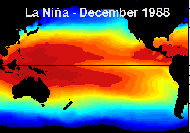
La Niña is characterized by unusually cold ocean temperatures in the Equatorial Pacific, compared to El Niño, which is characterized by unusually warm ocean temperatures in the Equatorial Pacific.

La Nina (cold) conditions - view of Pacific water temperatures
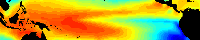
Normal Conditions
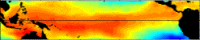
El Nino Conditions
Normal Equatorial Pacific Ocean surface temperatures (December 1993) are shown in the middle panel, including cool water, called the 'cold tongue', in the Eastern Pacific (in blue, on the right of the plot) and warm water in the Western Pacific (in red, on the left). Strong La Niña conditions during December 1998 are shown in the top panel. The Eastern Pacific is cooler than usual, and the cool water extends farther westward than is usual (see the blue color extending further to the left). Strong El Niño conditions, in December 1997, are shown on the bottom panel, with warm water (red) extending all along the equator. El Niño and La Niña are opposite phases of the El Niño-Southern Oscillation (ENSO) cycle, with La Niña sometimes referred to as the cold phase of ENSO and El Niño as the warm phase of ENSO.
Recent La Niña and El Niño events
Different La Niña and El Niño events vary in strength
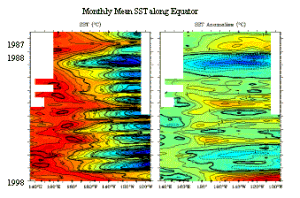
Mean and anomalies of sea surface temperature from 1986 to present, showing El Niño events 1986-1987, 1991-1992, 1993, 1994 and 1997 and La Niña events in 1985 and 1995.
In the left hand panel, you see the sea surface temperature at the Equator in the Pacific Ocean (Indonesia is towards the left, South America is towards the right). Time is increasing downwards from 1986 at the top of the plot, to the present, at the bottom of the plot. The first thing to note is the blue "scallops" on the right of the plot, in the eastern Pacific. These indicate the cool water typically observed in the Eastern Pacific (called the "cold tongue"). Cold tongue temperatures vary seasonally, being warmest in the northern hemisphere springtime and coolest in the northern hemisphere fall. The red color on the left is the warm pool of water typically observed in the western Pacific Ocean. El Niño is an exaggeration of the usual seasonal cycle.
During the El Niño in 1986-1987, you can see the warm water (red) penetrating eastward in the Spring of 1987. There is another El Niño in 1991-1992, and you can see the warm water penetrating towards the east in the northern hemisphere spring of 1992. The 1997-1998 El Niño (at the bottom) is unusually strong.
El Niño and La Niña years are easier to see in the anomalies on the right hand panel. The anomalies show how much the sea surface temperature is different from the usual value for each month. Water temperatures significantly warmer than the norm are shown in red, and water temperatures cooler than the norm are shown in blue. In the right-hand plot of sea surface temperature anomalies, it is very easy to see El Niño's, with water warmer than usual (red) in the eastern Pacific, during in 1986-1987, 1991-1992, 1993, 1994 and 1997-1998. It is unusual for El Niños to occur in such rapid succession, as was the case during 1990-1994.
Notice the very cool water (blue), in the Eastern Pacific, in 1988-1989, and the somewhat less cool water in 1995. These are La Niña events, which occur after some (but not all) El Niños. Typically, El Niño occurs more frequently than La Niña.
La Niña impact on the global climate
Global climate La Niña impacts tend to be opposite those of El Niño impacts. In the tropics, ocean temperature variations in La Niña tend to be opposite those of El Niño.
At higher latitudes, El Niño and La Niña are among a number of factors that influence climate. However, the impacts of El Niño and La Niña at these latitudes are most clearly seen in wintertime.
The origin of the names, La Niña and El Niño
La Niña is sometimes referred to as El Viejo
El Niño was originally recognized by fisherman off the coast of South America as the appearance of unusually warm water in the Pacific ocean, occurring near the beginning of the year. El Niño means The Little Boy or Christ child in Spanish. This name was used for the tendency of the phenomenon to arrive around Christmas.
La Niña means The Little Girl. La Niña is sometimes called El Viejo, anti-El Niño, or simply "a cold event" or "a cold episode".
Selected references and publications
- Philander, S.G.H., 1990: El Niño, La Niña and the Southern Oscillation. Academic Press, San Diego, CA, 289 pp.
- Hayes, S.P., L.J. Mangum, J. Picaut, A. Sumi, and K. Takeuchi, 1991: TOGA-TAO: A moored array for real-time measurements in the tropical Pacific Ocean. Bull. Am. Meteorol. Soc., 72, 339-347. (abstract available)
- McPhaden, M.J., 1993: TOGA-TAO and the 1991-93 El Niño-Southern Oscillation Event. Oceanography, 6, 36-44. (entire paper available)
- Lee, Martin E., and Chelton, Dudley, Oceanic Kelvin/Rossby Wave Influence on North American West Coast Precipitation, NOAA Technical Memorandum (NWS WR-253)
- El Niño references: TAO refereed journal articles and other TAO papers.
- NOAA Reports to the Nation - El Niño and Climate Prediction