Solid Waster Resources

Solid Waste Resources
back to Contents of Entire Course...
Disposal Methods
Historical Patterns in
Waste Disposal
Sanitary Landfills Site
Selection
Pollution from Sanitary
Landfills
Incineration
Source Reduction
adapted to HTML from lecture notes of Prof. Stephen A. Nelson Tulane
University Up until the last 5 to 10 years or so, the major form of solid waste disposal in many places was burying in landfills. Today, we can only use landfills to deposit ash from incineration or debris from construction or demolition processes.
Waste Energy Sites - Incineration sites that use the burning process to produce electricity.
Disposal Methods
- Source Reduction - Reducing the amount of solid waste that is initially produced. This is the ideal solution, but so far, has been unsuccessful.
- Reducing Waste Volume
- Pigs -- A major source of reducing food wastes until the 1960's. This practice was stopped because diseases were spread in this manner.
- In-sink garbage disposals -- This method doesn't really reduce the volume of waste; rather, it transfers the waste into the sewer system (or into the septic tanks).
- Composting -- Really a method of recycling, it works very well to reduce the volume of organic wastes. The waste can the be used in gardens, fields etc.
- Recycling -- Australia recycled much of its garbage until WWII, when it became unpopular to recycle.
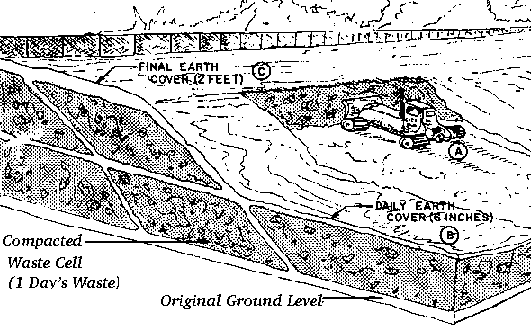
- Open dumps and sanitary landfills -- Open dumps are often sited in wetlands, which, along with the fact that they are unlined, make them very unsafe, in terms of water contamination. Sanitary landfills are also covered up daily, to reduce vermin and smell.
- Incineration-- Beginning to play a much larger part in solid waste disposal. Incinerated waste has a much smaller volum as ash, which is a lot easier (and safer) to dispose of.
- Ocean dumping This practice is no longer allowed, although at one time it was fairly popular.
- Illegal Dumping-- A prolific disposal method, whether individually (tossing trash out of a window while driving down the highway) or on a large scale by industries.
Historical Patterns in Waste Disposal
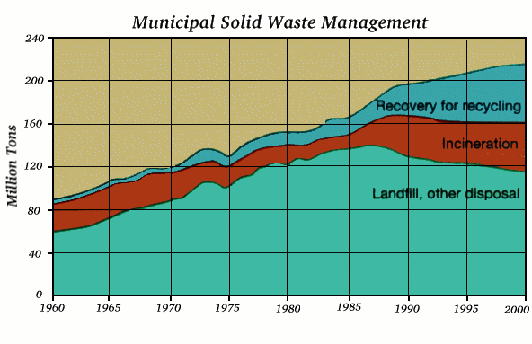
- in many developed countries, we produce a ton of garbage per person per year. This breaks down to a couple of kilograms per person per day.
- Recently, near major cities, the policy of Integrated Waste Management has become more popular, which involves the following:
- Recycle -- First, all of the waste that can be recycled is.
- Incinerate -- The remainder of the waste is incinerated, to reduce its volume (by 90%) and transform it all into ash. Also, the excess heat generated from the incineration process is used to spin a turbine, generating electricity.
- Landfill -- The ash, along with waste from construction and demolition practices, is then dumped into a landfill.
| Number of | 1986 | 1991 | 1994 | |
|---|---|---|---|---|
| Landfills | 12 | 9 | 6 | |
| Incinerators | 2 | 5 | 5 | |
| Recycling Programs |
2 - Pilot | 15 | 15 | |
| Composting | - | ? | 7 | |
| Shipping | - | 7 | ? | |
| |
|
|
|
|
| Percent of Trash disposed of by | 1987 | 1991 | 1994 | 1997 |
| Landfills | 80% | 25% | 3% | 0% |
| Incinerators | 6% | 39% | 47% | 46% |
| Recycling | 1% | 19% | 25% | 25% |
| Shipping | 13% | 18% | 25% | 29% |
in many places llaw now forbids placing raw garbage into landfills, due to the dangers of groundwater contamination from landfill leeching.
Sanitary Landfills Site Selection
- Should be above the water table, to minimize interaction with groundwater.
- Preferably located in clay or silt.
- Do not want to place in a rock quarry, as water can leech through the cracks inherent in rocks into a water fracture system.
- Do no want to locate in sand or gravel pits, as these have high leeching. Unfortunately, most of Long Island is sand or gravel, and many lanfills are located in gravel pits, after they were no longer being used.
- Do not want to locate in a flood plain. Most garbage tends to be less dense than water, so if the area of the landfill floods, the garbage will float to the top and wash away downstream.
Pollution from Sanitary Landfills
Volatiles (from Anaerobic processes) include:- Methane (CH4)
- Ammonia (NH3)
- Hydrogen Sulfide
- Leachates include: Heavy Metals (Pb, Cr, Cd)
- Soluble Salts (Chloride, Nitrate, Sulfate)
- Organic Compounds
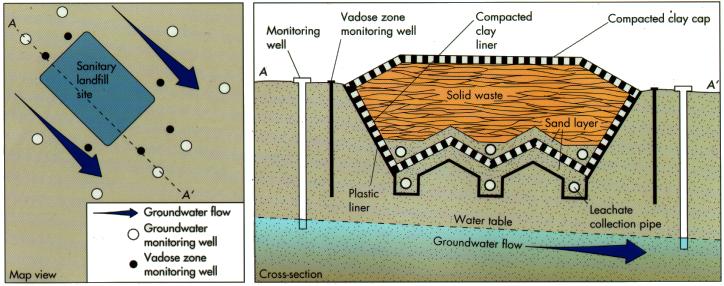
Modern Landfill with plastic, clay liner and collection pipes to prevent leachate from entering the groundwater. Vadose Wells are situated in the unsaturated zone to monitor gas emissions. Things do not biodegrade in a landfill. Anaerobic processes are the only ones that take place after the landfill is sealed, and this makes organic decay very slow, as there is no oxygen or moisture tosupport the decomposition process.
Incineration
- Reduces the volume of solid waste - only the ash (approximately 90% reduced in volume) needs landfilling.
- Metals may be recovered from the incineration process, and are usually recycled by the incineration plant.
- Converts waste to energy, by using the heat given off by the incinerating waste to fuel a turbine, which is used to generate electricity.
- May result in air pollution (although recent regulations severely restrict the amount of pollution from incineration).
- Ash may be a hazardous waste (this is not true in most cases, although there are exceptions).
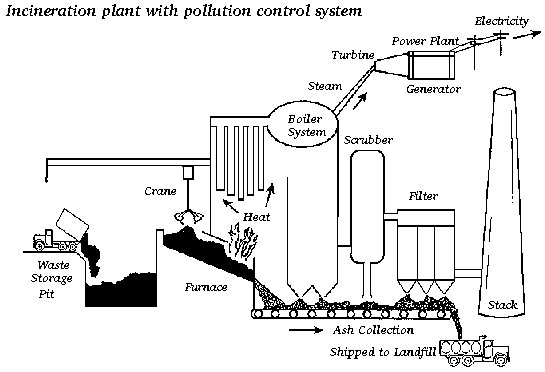
Burns at 1800° F.
Source Reduction
The following are all methods of initiating source reduction:- Do not purchase as much, or reduce use.
- Purchase products with reduced toxics.
- Purchase environmentally preferred products.
- Purchase products with less packaging.
- Purchase concentrated products.
- Purchase products in bulk or larger sizes.
- Buy multiple use products.
- Do not replace for style.
- Purchase more durable products.
- Maintain properly and repair instead of replace.
- Purchase reusable products, and then reuse or donate to charity.
- Purchase more efficient products, or use products more efficiently.
- Purchase manufactured product. Borrow, share, or rent product.