Soils


Soils
Contents of entire course
Soil
Chemical Reactions
Biological Effects
Carbon in the Soil
Time to develop soil
Soil Erosion
Soil Pollution
see also...
Soil Processes
and
Web based Soil
Activities and Investigations
To a geologist, or an earth or soil scientist,soil is material that supports plant growth. It is usually within the top meter of material on the ground.
- Soil is an open system leaching from top down.
- To an engineering geologist, however, soil refers to any unconsolidated material overlying the bedrock.
- Type of soil is primarily a function of climate, organic activity, relief, and time. (ClORPT)
Where:
- Cl = Climate (warmer, wetter climates produce soil faster)
- O = Organic Activity (Roots and animal burrowings, as well as acids from organic sources, have a major role).
- R = Relief of Land (Soil tends to be washed away from the tops of mountains and gathers in the lowlands.)
- P = Parent Material (porous materials and silty sands will decay into soil faster than granites.)
- T = Time (The more time processes are at work, the more soil forms.)
- It is not strongly dependent on parent material..
Organic Matter
- Organic matter consists of plant litter on the surface, and humus dispersed throughout the soil profile.
- Organic matter is an important component of soil.
- Trees, shrubs, herbs and grass produce plant litter.
- The plant litter becomes humus, which is finely divided organic matter which the plants can use.
- Fifty years of farming may result in the loss of 20 to 40% of organic matter in temperate areas.
Formation of Soil
- Soil formation occurs in two main processes:
- Mechanical Breakdown - Ice or salts get into cracks, and break down material. Also, expansion and contraction from heating and cooling breaks down material.
- Chemical Breakdown - Mostly in the form of the reaction of water on rocks near the surface, although also occurs from acidic breakdown. This process is mainly aerobic (involving oxygen) vs anaerobic (not involving oxygen).
Chemical Reactions
Solution
- Several acids from plants and atmosphere such as the Carbonic, sulfuric, nitric, and various organic acids. From the atmosphere, for example:
- Limestone dissolves relatively easily
- Silicates dissolve more slowly leave dominantly clays and Al and Fe oxides
- Oxydation and Hydration - Similar to the formation of Rust.
- Hydrolysis - Formation of clays.
CO2 + H2O = H2CO3
Biological Effects
- These are a combination of mechanical and chemical effects.
- Mechanical - Roots, animal burrowings, etc.
- Chemical - Plants produce acids and other chemicals that react with the rocks and soil.
Biologial Activity
- One kilogram of soil may contain as much as 500 billion bacteria, 10 billion actinomycetes, and one billion other fungi.
- Bacteria and fungi are consumers of organics, which is dominantly an aerobic process. At temperatures above 75°F, there is little humus present in the soil.
- Some bacteria fix nitrogen on leguminous plants.
- Soil is loaded with roots.
- Burrowing animals mix and aerate soil.
Soil Color
- Color is independent of bedrock.
- Black color in soil is due to humus.
- Red, yellow or brown color is due to oxidized iron and a low humus content.
- Grayish and bluish colored soil in humid climate is due to reduced iron in a boggy soil.
- Gray to white soil in dry climate is due to low humus and high salt content.
- Example:Long Island has black or brown top soil. Maryland and areas further south tend to have a more reddish soil. This is due to the fact that it is warmer there, so there is less humus to darken the soil.
Carbon in the Soil
- Soil has three times as much carbon as all land vegetation.
- Each year soils release 5% of their carbon to the atmosphere as CO2. This is a quantity 10 times that produced by the burning of fossil fuels.
- Arctic tundra, peat and wetland soils are world reservoirs of soil carbon.
- Methane Hydrate (CH4 + H2O) (A greenhouse gas) - There is more methane hydrate in the oceans and arctic soils than all the fossil fuels in the world conbined. It is very pervasive throughout the tundra soil. If the tundra is heated up (by global warming, for example), the carbon in the soil may become oxidized to CO2 and there may be the release of methane to the atmosphere from the methane hydrate in the permafrost. Both CO2 and methane are greenhouse gases. This is an example of positive feedback, for the greenhouse effect.
Time to develop soil
- For 1 meter of soil to develop, it takes:
- 20,000 to 100,000 years, if breaking down granite in an equatorial region.
- Roughly 10,000 years, if breaking down glacial deposits in the midwest praries ( the same amount of time since the last ice age).
Soil Erosion
Soil erosion comes from
several sources.- Water -- a major source. Can leave behind several strong erosion features:
- Rills -- Relatively small scale. Farmers can easily plow over rills.
- Gullies -- Larger. Can not be plowed over, and increase furthur erosion.
- Siltation -- Water erosion also results in the sedimentation of streams. Soil that is eroded off the land is dumped into streams and ponds, clogging them up. When this occurs in areas of high fertilizer use, this can also cause hypoxia in streams from eutrophication initiated by fertilizer washoff.
- Wind -- can be a major factor, especially in fairly dry regions. Example: The Dust bowl, in the 1930's.
- Mitigation -- ways to stop soil erosion.
- Conservation farming
- Green manure -- for example, alfalfa or clover. These crops cover the fields in winter and help to enrich soil while growing as well as when they are plowed under in spring..
- Windbreaks Trees planted along the edges of fields.
- Contour Plowing -- plow parallel to the contours. Helps prevent erosion by slowing runoff down sloped land areas.
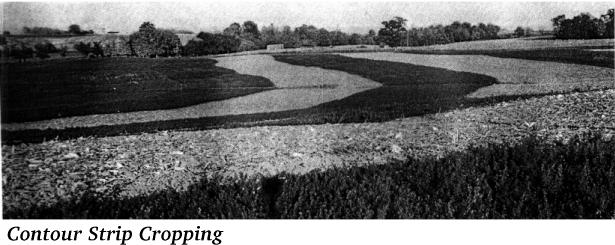
- Strip-cropping -- plant parallel to contours alternating plant types. One a type that has exposed soil, such as corn, the other type that completely covers the ground such as alfalfa.
- Terracing -- shaping steep terrain to provide flat areas suitable for farming.
- Soil erosion can also result from over-grazing.
- Cutting down forests to provide grazing land or farmland often results in massive soil erosion, because the roots decay and can no longer hold the soil.
- Off road vehicles also do damage and increase soil erosion by tearing up the ground and killing vegetation
During the early stages of development (such as new construction for houses) there is extreme erosion, since for an extended period of time, there is nothing protecting the soil and ground from being washed away.
Soil Pollution
Inorganic Soil Pollution
- Often found in the vicinity of mines.
- Also get some from farming, in the form of pesticides.
- Industrial processes create a lot of inorganic pollutants.
Lead, Arsenic, Mercury, and Cadmium (all main industrial pollutants) tend to accumulate in the human body for long periods of time, as they are difficult to flush out of our system. Organic Soil Pollution
- The main source of organic pollution is from herbicides, pesticides, and fungicides used in agriculture and in gardens.
- Oil spills are another large organic soil pollution source.
Salinisation
- Associated with irrigation. The water used for irrigation has dissolved salts that are left behind as the water evaporates
- Affects 25% of farmlands.
- Dilution with water -- uses up and contaminates a lot of water.
- Washing with water -- also uses up and contaminates a lot of water.
- Vapor extraction -- expensive process - deals with pumping the vaporous fumes out of the ground, and into the atmosphere.
- Contaminant-eating bacteria - ideal in that it is fairly inexpensive and extremely effective. However, is a very slow process. This process can be somewhat aided by building a "High Technology Restaurant for Bacteria", which add oil and/or other nutrients into polluted soils and groundwaters in order to aid the feeding of contaminant-eating bacteria.
- Contaminant-concentrating plants -- certain plants concentrate specific elements (for example, Loco weed concentrates selenium from the soil.). Over time the soil becomes depleted in the element. Each year the plants can be harvested and disposed of or sometimes the element can be extracted for use.