Metamorphism and Metamorphic Rocks


Metamorphism and Metamorphic Rocks
back to Contents of Entire Course...
Definition of Metamorphism
Grade of Metamorphism
Retrograde Metamorphism
Factors that Control
Metamorphism
Responses of Rock to
Increasing Metamorphic Grade
Metamorphism of Basalts and Gabbros
Metamorphism of Limestone and
Sandstone
Types of Metamorphism
Metamorphic Facies
Metamorphism and Plate
Tectonics
adapted to HTML from lecture notes of Prof. Stephen A. Nelson Tulane University
Definition of Metamorphism
The word "Metamorphism" comes from the Greek: Meta = change, Morph = form, so metamorphism means to change form.In geology this refers to the changes in mineral assemblage and texture that result from subjecting a rock to pressures and temperatures different from those under which the rock originally formed.
Note that Diagenesis is also a change in form that occurs in sedimentary rocks. In geology, however, we restrict diagenetic processes to those which occur at temperatures below 200oC and pressures below about 300 MPa (MPa stands for Mega Pascals), this is equivalent to about 3000 atmospheres of pressure.
Metamorphism, therefore occurs at temperatures and pressures higher than 200oC and 300 MPa. Rocks can be subjected to these higher temperatures and pressures as rocks become buried deeper in the Earth. Such burial usually takes place as a result of tectonic processes such as continental collisions or subduction.
The upper limit of metamorphism occurs at the pressure and temperature of wet partial melting of the rock in question. Once melting begins, the process changes to an igneous process rather than a metamorphic process.
Grade of Metamorphism
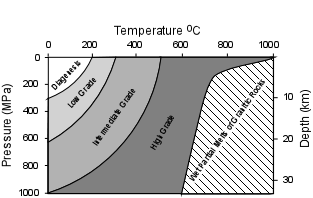
As the temperature and/or pressure increases on a body of rock we say the rock undergoes prograde metamorphism or that the grade of metamorphism increases. Metamorphic grade is a general term for describing the relative temperature and pressure conditions under which metamorphic rocks form.
Low-grade metamorphism takes place at temperatures between about 200 to 320oC, and relatively low pressure. Low grade metamorphic rocks are characterized by an abundance of hydrous minerals, minerals that contain water, H2O, in their crystal structure.
Examples of hydrous minerals that occur in low grade metamorphic rocks:
- Clay Minerals
- Serpentine
- Chlorite
High-grade metamorphism takes place at temperatures greater than 320oC and relatively high pressure. As grade of metamorphism increases, hydrous minerals become less hydrous, by losing H2O and non-hydrous minerals become more common.
- Examples of less hydrous minerals and non-hydrous minerals that characterize high grade metamorphic rocks:
- Muscovite - hydrous mineral that eventually disappears at the highest grade of metamorphism
- Biotite - a hydrous mineral that is stable to very high grades of metamorphism.
- Pyroxene - a non hydrous mineral.
- Garnet - a non hydrous mineral
Retrograde Metamorphism
As temperature and pressure fall due to erosion of overlying rock or due to tectonic uplift, one might expect metamorphism to a follow a reverse path and eventually return the rocks to their original unmetamorphosed state. Such a process is referred to as retrograde metamorphism. If retrograde metamorphism were common, we would not commonly see metamorphic rocks at the surface of the Earth. Since we do see metamorphic rocks exposed at the Earth's surface retrograde metamorphism does not appear to be common.
The reasons for this include:
- chemical reactions take place more slowly as temperature is decreased
- during prograde metamorphism, fluids such as H2O and CO2 are driven off, and these fluids are necessary to form the hydrous minerals that are stable at the Earth's surface.
Chemical reactions take place more rapidly in the presence of fluids, but if the fluids are driven off during prograde metamorphism, they will not be available to speed up reactions during retrograde metamorphism.
Factors that Control Metamorphism
Metamorphism occurs because some minerals are stable only under certain conditions of pressure and temperature. When pressure and temperature change, chemical reactions occur to cause the minerals in the rock to change to an assemblage that is stable at the new pressure and temperature conditions. But, the process is complicated by such things as how the pressure is applied, the time over which the rock is subjected to the higher pressure and temperature, and whether or not there is a fluid phase present during metamorphism.
- Temperature increases with depth in the Earth along the Geothermal Gradient. Thus higher temperature can occur by burial of rock.
- Temperature can also increase due to igneous intrusion.
- Pressure increases with depth of burial, thus, both pressure and temperature will vary with depth in the Earth. Pressure is defined as a force acting equally from all directions. It is a type of stress, called hydrostatic stress, or uniform stress. If the stress is not equal from all directions, then the stress is called a differential stress
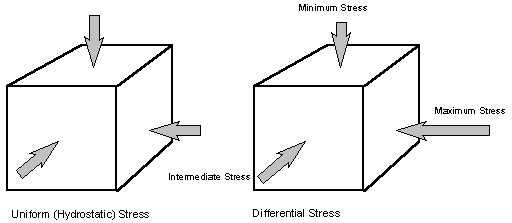
- If differential stress is present during metamorphism, it can have a profound effect on the texture of the rock.
- rounded grains can become flattened in the direction of maximum stress.

- minerals that crystallize or grow in the differential stress field can have a preferred orientation. This is especially true of the sheet silicate minerals (the micas: biotite and muscovite, chlorite, talc, and serpentine).
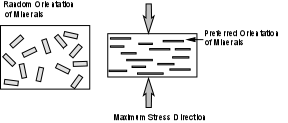
These sheet silicates will grow with their sheets orientated perpendicular to the direction of maximum stress. Preferred orientation of sheet silicates causes rocks to beeasily broken along approximately parallel sheets. Such a structure is called a foliation.
- Fluid Phase - Any existing open space between mineral grains in a rocks can potentially contain a fluid. This fluid is mostly H2O, but contains dissolved mineral matter. The fluid phase is important because chemical reactions that involve one solid mineral changing into another solid mineral can be greatly speeded up by having dissolved ions transported by the fluid. Within increasing pressure of metamorphism, the pore spaces in which the fluid resides is reduced, and thus the fluid is driven off. Thus, no fluid will be present when pressure and temperature decrease and, as discussed earlier retrograde metamorphism will be inhibited.
- Time - The chemical reactions involved in metamorphism, along with recrystallization, and growth of new minerals are extremely slow processes. Laboratory experiments suggest that the longer the time available for metamorphism, the larger are the sizes of the mineral grains produced. Thus coarse grained metamorphic rocks involve long times of metamorphism. Experiments suggest that the time involved is millions of years
Responses of Rock to Increasing Metamorphic Grade
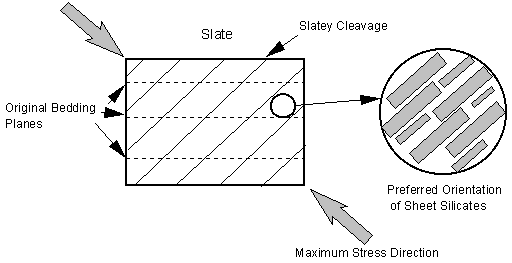
Slate - Slates form at low metamorphic grade by the growth of fine grained chlorite and clay minerals. The preferred orientation of these sheet silicates causes the rock to easily break along the planes parallel to the sheet silicates, causing a slatey cleavage. Note that in the case shown here, the maximum stress is applied at an angle to the original bedding planes, so that the slatey cleavage has developed at an angle to the original bedding.
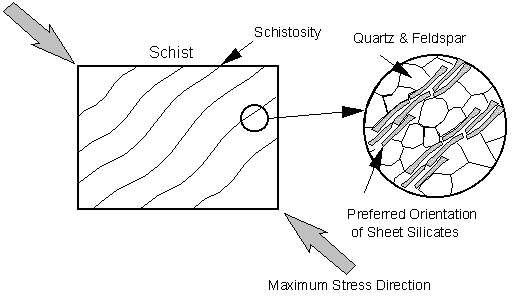
Schist - The size of the mineral grains tends to enlarge with increasing grade of metamorphism. Eventually the rock develops a near planar foliation caused by the preferred orientation of sheet silicates (mainly biotite and muscovite). Quartz and Feldspar grains, however show no preferred orientation. The irregular planar foliation
at this stage is called schistosity.
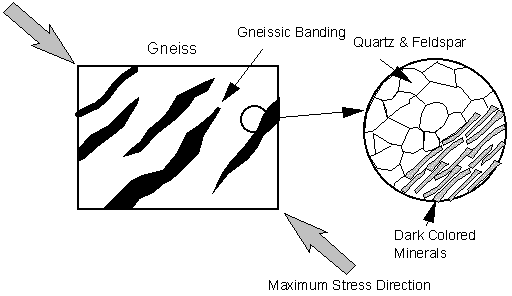
Gneiss - As metamorphic grade increases, the sheet silicates become unstable and dark colored minerals like hornblende and pyroxene start to grow.These dark colored minerals tend to become segregated in distinct bands through the rock, giving the rock a gneissic banding. Because the dark colored minerals tend to form elongated crystals, rather than sheet- like crystals, they still have a preferred orientation with their long directions perpendicular to the maximum differential stress.
Granulite - At the highest grades of metamorphism all of the hydrous minerals and sheet silicates become unstable and thus there are few minerals present that would show a preferred orientation. The resulting rock will have a granulitic texture that is similar to a phaneritic texture in igneous rocks.
Metamorphism of Basalts and Gabbros
- Greenschist - Olivine, pyroxene, and plagioclase in an original basalt change to amphiboles and chlorite (both commonly green) as water in the pore spaces reacts with the original minerals at temperatures and pressures of low grade metamorphism.
- Amphibolite - As pressure and temperature increase to intermediate grades of metamorphism, only dark colored amphiboles and plagioclase survive and the resulting rock is called an amphibolite.
- Granulite - At the highest grade of metamorphism the amphiboles are replaced by pyroxenes and garnets, the foliation is lost and a granulite that has a granulitic texture is produced.
Metamorphism of Limestone and Sandstone
- Marble - Since limestones are made up of essentially one mineral, Calcite, and calcite is stable over a wide range of temperature and pressure, metamorphism of limestone only causes the original calcite crystals to grow larger. Since no sheet silicates are present the resulting rock, a marble, does not show foliation.
- Quartzite - Metamorphism of sandstone originally containing only quartz, results in recrystallization and growth of the quartz, producing a non foliated rock called a quartzite
Types of Metamorphism
- Cataclastic Metamorphism - This type of metamorphism is due to mechanical deformation, like when two bodies of rock slide past one another along a fault zone. Heat is generated by the friction of sliding along the zone, and the rocks tend to crushed and pulverized due to the sliding. Cataclastic metamorphism is not very common and is restricted to a narrow zone along which the sliding occurred.
- Burial Metamorphism - When sedimentary rocks are buried to depths of several hundred meters, temperatures greater than 300oC may develop in the absence of differential stress. New minerals grow, but the rock does not appear to be metamorphosed. The main minerals produced are the Zeolites. Burial metamorphism overlaps, to some extent, with diagenesis, and grades into regional metamorphism as temperature and pressure increase.
Contact Metamorphism
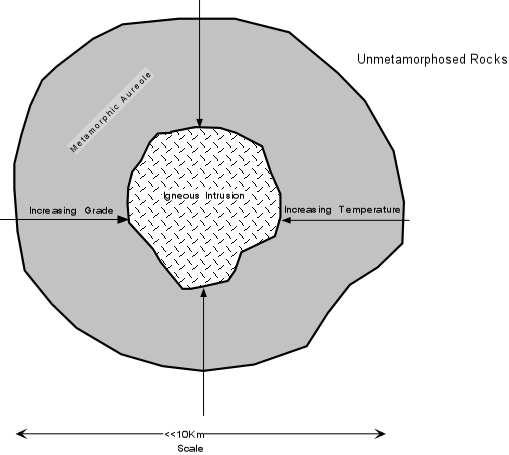
- Occurs adjacent to igneous intrusions and results from high temperatures associated with the igneous intrusion. Since only a small area surrounding the intrusion is heated by the magma, metamorphism is restricted to zone surrounding the intrusion, called a metamorphicaureole. Outside of the contact aureole, the rocks are unmetamorphosed. The grade of metamorphism increases in all directions toward the intrusion. Because temperature differences between the surrounding rock and the intruded magma are larger at shallow levels in the crust, contact metamorphism is usually referred to as high temperature, low pressure metamorphism. The rock produced is often a fine-grained rock that shows no foliation, called a hornfels
Regional Metamorphism
- This type of metamorphism occurs over large areas that were subjected to high degrees of deformation under differential stress.
Thus, it usually results in forming metamorphic rocks that are strongly foliated, such as slates, schists, and gniesses.
The differential stress usually results from tectonic forces that produce a compression of the rocks, such as when two continental masses collide with one another.
Thus, regionally metamorphosed rocks occur in the cores of mountain ranges or in eroded mountain ranges.
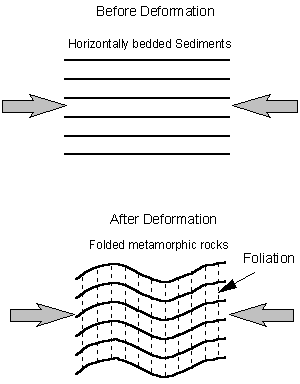
Compressive stresses result in folding of the rock, as shown below, and result in thickening of the crust which tends to push rocks down to deeper levels where they are subjected to higher temperatures and pressures
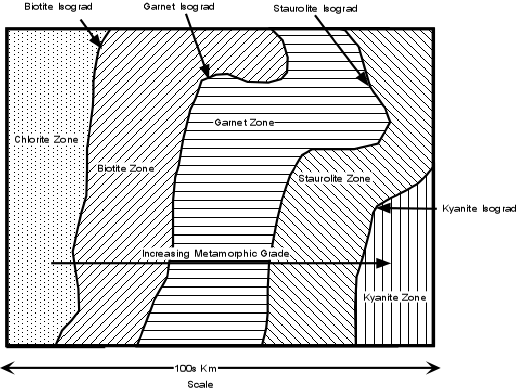
A map of a hypothetical regionally metamorphosed area is shown in the figure below. Most regionally metamorphosed areas can be divided into zones where a particular mineral, called and index mineral, is characteristic of the zone . The zones are separated by lines (surfaces in three dimensions) that mark the first appearance of the index mineral. These lines are called isograds (meaning equal grade) and represent lines (really surfaces) where the grade of metamorphism is equal.
Metamorphic Facies
>
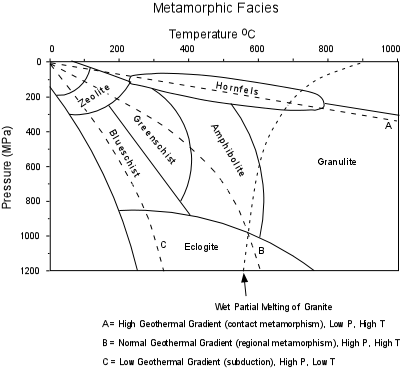
In general, metamorphic rocks do not change chemical composition much during metamorphism. The changes in mineral assemblages are due to changes in the temperature and pressure conditions of metamorphism. Thus the mineral assemblages that are observed must be an indication of the temperature and pressure environment that the rock was subjected to. This pressure and temperature environment is referred to as metamorphic Facies. (This is similar to the concept of sedimentary facies, in that a sedimentary facies is also a set of environmental conditions present during deposition).
The sequence of metamorphic facies observed in any metamorphic terrain, depends on the geothermal gradient that was present during metamorphism.&nbrp; A high geothermal gradient such as the one labeled "A" in the figure shown here, might be present around an igneous intrusion, and would result in metamorphic rocks belonging to the hornfels facies. Under a normal geothermal gradient, such as "B" in the figure, rocks would progress from zeolite facies to greenschist, amphibolite, and eclogite facies as the grade of metamorphism (or depth of burial) increased.
If a low geothermal gradient was present, such the one labeled "C" in the diagram, then rocks would progress from zeolite facies to blueschist facies to eclogite facies. Thus, if we know the facies of metamorphic rocks in the region, we can determine what the geothermal gradient must have been like at the time the metamorphism occurred.
Metamorphism and Plate Tectonics
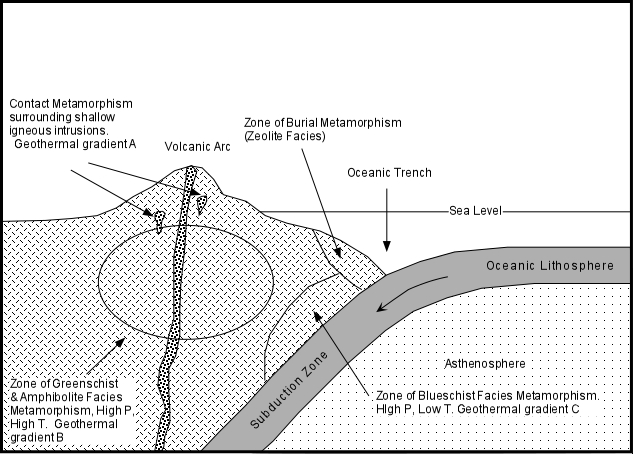
At present, the geothermal gradients observed are strongly affected by plate tectonics.
- Along zones where subduction is occurring, magmas are generated near the subduction zone and intrude into shallow levels of the crust. Because high temperature is brought near the surface, the geothermal gradient in these regions becomes high (geothermal gradient "A" in the figure above), and contact metamorphism (hornfels facies) results.
- Because compression occurs along a subduction margin (the oceanic crust moves toward the volcanic arc) rocks may be pushed down to depths along either a normal or slightly higher than normal geothermal gradient ("B" in the figure above). Actually the geothermal gradient is likely to be slightly higher than B, because the passage of magma through the crust will tend to heat the crust somewhat. In these regions we expect to see greenschist, amphibolite, and granulite facies metamorphic rocks.