Mass Wasting


Mass Wasting
back to Contents of Entire Course...
Gravity
The Role of Water
Mass-Wasting Processes
Mass-Wasting in Cold Climates
Triggering of Mass-Wasting Events
adapted to HTML from lecture notes of Prof. Stephen A. Nelson Tulane
UniversityMass-wasting is the down-slope movement of Regolith (loose uncemented mixture of soil and rock particles that covers the Earth's surface) by the force of gravity without the aid of a transporting medium such as water, ice, or wind. Still, as we shall see, water plays a key role. Mass-wasting is part of a continuum of erosional processes between weathering and stream transport. Mass-wasting causes regolith to move down-slope where sooner or later the loose particles will be picked up by another transporting agent and eventually moved to a site of deposition such as an ocean basin or lake bed. In order for regolith to move in a mass wasting process it must be on a slope, since gravity will only cause motion if the material is on a slope.
Gravity
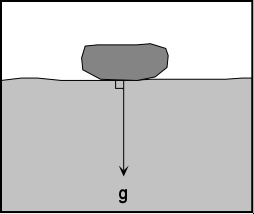
Gravity is a force that acts everywhere on the Earth's surface, pulling everything in a direction toward the center of the Earth. On a flat surface, parallel to the Earth's surface the force of gravity acts downward. So long as the material remains on the flat surface it will not move under the force of gravity.
On a slope, the force of gravity can be resolved into two components: a component acting perpendicular to the slope, and a component acting tangential to the slope.
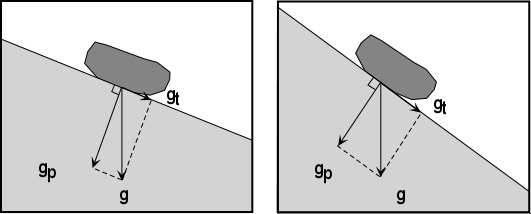
- The perpendicular component of gravity, gp, helps to hold the object in place on the slope.
- The tangential component of gravity, gt, causes a shear stress parallel to the slope and helps to move the object in the down-slope direction.
- On a steeper slope, the shear stress or tangential component of gravity, gt, increases, and the perpendicular component of gravity, gp, decreases.
- Another force resisting movement down the slope is grouped under the term shear strength and includes frictional resistance and cohesion among the particles that make up the object.
- When the sheer stress becomes greater than the combination of forces holding the object on the slope, the object will move down-slope.
The Role of Water
Although water is not directly involved as the transporting medium in mass-wasting processes, it does play an important role. Think about building a sandcastle on the beach. If the sand is totally dry, it is impossible to build a pile of sand with a steep face like a castle wall. If the sand is somewhat wet, however, one can build a vertical wall. If the sand is too wet, then it flows like a fluid and cannot remain in position as a wall.
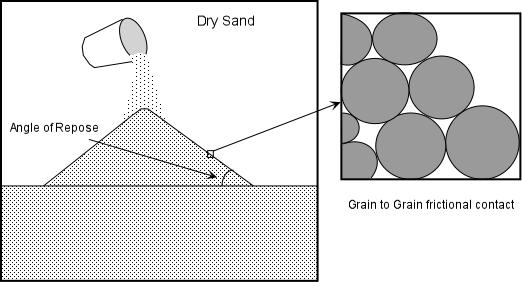
Dry unconsolidated grains will form a pile with a slope angle determined by the angle of repose. The angle of repose is the steepest angle at which a pile of unconsolidated grains remains stable, and is controlled by the frictional contact between the grains. In general, for dry materials the angle of repose increases with increasing grain size, but usually lies between about 30 and 37 degrees.
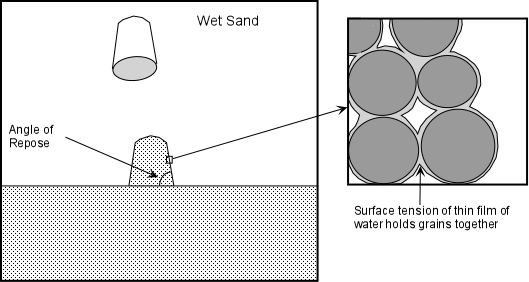
Slightly wet unconsolidated materials exhibit a very high angle of repose because surface tension between the water and the grains tends to hold the grains in place.
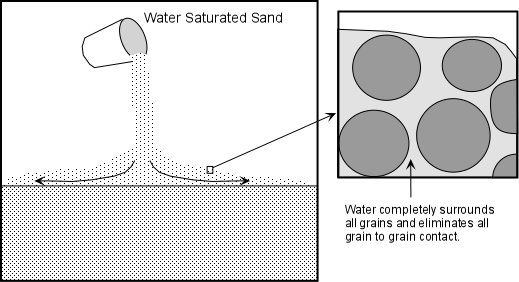
When the material becomes saturated with water, the angle of repose is reduced to very small values and the material tends to flow like a fluid. This is because the water gets between the grains and eliminates grain to grain frictional contact.
Mass-Wasting Processes
The down-slope movement of material, whether it be bedrock, regolith, or a mixture of these, is commonly referred to as a landslide. All of these processes generally grade into one another, so classification of mass-wasting processes is somewhat difficult. We will use the classification used by your textbook, which divides mass wasting processes into two broad categories and further subdivides these categories.
Slope Failures- a sudden failure of the slope resulting in transport of debris down hill by sliding, rolling, falling, or slumping.
- Sediment Flows- debris flows down hill mixed with water or air.
- Slope Failures
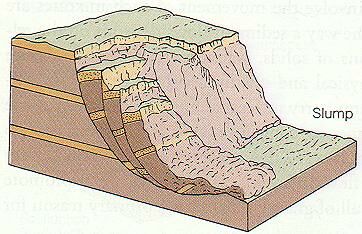
Slumps - types of slides wherein downward rotation of rock or regolith occurs along a curved surface. The upper surface of each slump block remains relatively undisturbed, as do the individual blocks. Slumps leave arcuate scars or depressions on the hill slope. Heavy rains or earthquakes usually trigger slumps.
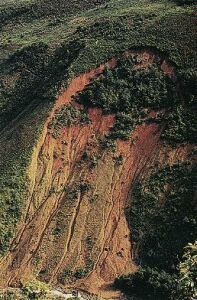
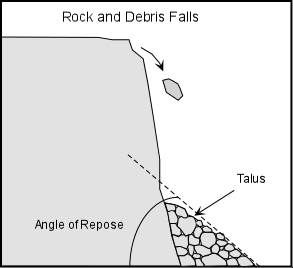
Rock Falls and Debris Falls - Rock falls occur when a piece of rock on a steep slope becomes dislodged and falls down the slope. Debris falls are similar, except they involve a mixture of soil, regolith, and rocks. A rock fall may be a single rock, or a mass of rocks, and the falling rocks can dislodge other rocks as they collide with the cliff. At the base of most cliffs is an accumulation of fallen material termed talus. The slope of the talus is controlled by the angle of repose for the size of the material. Since talus results from falling large rocks or masses of debris the angle of repose is usually greater than it would be for sand.
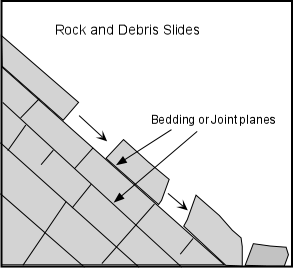
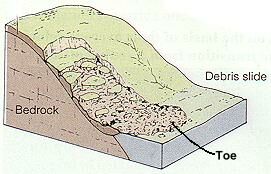
Rock Slides and Debris Slides - Rock slides and debris slides result when rocks or debris slide down a pre-existing surface, such as a bedding plane or joint surface. Piles of talus are common at the base of a rock slide or debris slide.
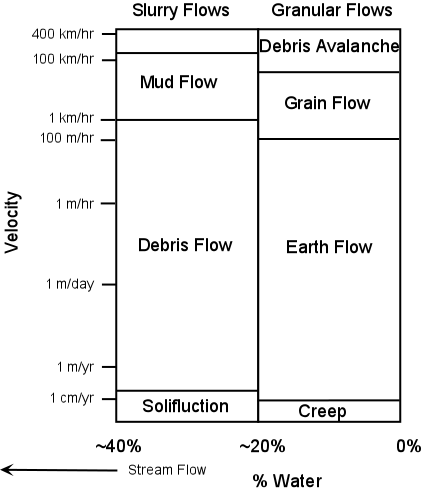
Sediment Flows Sediment flows occur when sufficient force is applied to rocks and regolith that they begin to flow down slope. A sediment flow is a mixture of rock, regolith with some water. They can be broken into two types depending on the amount of water present.
- Slurry Flows- are sediment flows that contain between about 20 and 40% water. As the water content increases above about 40% slurry flows grade into streams. Granular Flows - are sediment flows that contain between 20 and 0% water. Note that granular flows are possible with little or no water. Fluid-like behavior is given these flows by mixing with air.
Each of these classes of sediment flows can be further subdivided on the basis of the velocity at which flowage occurs.
Slurry Flows
- Solifluction - flowage at rates measured on the order of centimeters per year of regolith containing water. Solifluction produces distinctive lobes on hill slopes . These occur in areas where the soil remains saturated with water for long periods of time.
- Debris Flows-these occur at higher velocities than solifluction, and often result from heavy rains causing saturation of the soil and regolith with water. They sometimes start with slumps and then flow down hill forming to lobes with an irregular surface consisting of ridges and furrows.
- Mudflows- a highly fluid, high velocity mixture of sediment and water that has a consistency of wet concrete. These usually result from heavy rains in areas where there is an abundance of unconsolidated sediment that can be picked up by streams. Thus after a heavy rain streams can turn into mudflows as they pick up more and more loose sediment. Mudflows can travel for long distances over gently sloping stream beds. Because of their high velocity and long distance of travel they are potentially very dangerous.
- Creep- the very slow, usually continuous movement of regolith down slope. Creep occurs on almost all slopes, but the rates vary. Evidence for creep is often seen in bent trees, offsets in roads and fences, and inclined utility poles .
- Earthflows - are usually associated with heavy rains and move at velocities between several cm/yr and 110s of m/day. They usually remain active for long periods of time. They generally tend to be narrow tongue-like features that begin at a scarp or small cliff
- Grain Flows - usually form in relatively dry material, such as a sand dune, on a steep slope. A small disturbance sends the dry unconsolidated grains moving rapidly down slope.
- Debris Avalanches - These are very high velocity flows of large volume mixtures of rock and regolith that result from complete collapse of a mountainous slope. They move down slope and then can travel for considerable distances along relatively gentle slopes. They are often triggered by earthquakes and volcanic eruptions.
Mass-Wasting in Cold Climates
Mass-wasting in cold climates is governed by the fact that water is frozen as ice during long periods of the year. Ice, although it is solid, does have the ability to flow, and freezing and thawing cycles can also contribute to movement.
- Frost Heaving - this process is large contributor to creep in cold climates. When water saturated soils freeze, they expand, pushing rocks and boulders on the surface upward perpendicular to the slope. When the soil thaws, the boulders move down vertically resulting in a net down slope movement.
- Gelifluction - Similar to solifluction, this process occurs when the upper layers of soil thaw during the warmer months resulting in water saturated soil that moves down slope.
- Rock Glaciers - a lobe of ice-cemented rock debris (mostly rocks with ice between the blocks) that slowly moves downhill
Subaqueous Mass-Wasting
Mass wasting processes also occur on steep slopes in the ocean basins. A slope failure can occur due to over-accumulation of sediment on slope or in a submarine canyon, or could occur as a result of a shock like an earthquake. Slumps, debris flows, and landslides are common.
Triggering of Mass-Wasting Events
A mass-wasting event can occur any time a slope becomes unstable. Sometimes, as in the case of creep or solifluction, the slope is unstable all of the time, and the process is continuous. But other times, triggering events can occur that cause a sudden instability to occur.
- Shocks - A sudden shock, such as an earthquake may trigger a slope instability. Minor shocks like heavy trucks rambling down the road, trees blowing in the wind, or man made explosions can also trigger mass-wasting events.
- Slope Modification - modification of slope either by humans or by natural causes can result in changing the slope angle so that it is no longer at the angle of repose. A mass-wasting event can then restore the slope to its angle of repose.
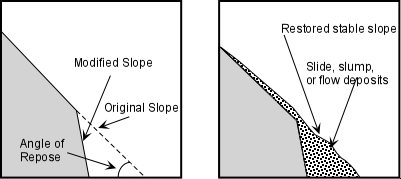
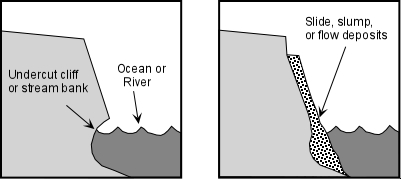
Undercutting
- streams eroding their banks or surf action along a coast can undercut a slope making it unstable.
Exceptional Precipitation - heavy rains can saturate regolith reducing grain to grain contact and reducing the angle of repose, thus triggering a mass-wasting event. Volcanic Eruptions - produce shocks like explosions and earthquakes. They can also cause snow to melt or empty crater lakes, rapidly releasing large amounts of water that can be mixed with regolith to reduce grain to grain contact and result in debris flows, mudflows, and landslides.
Submarine Slope Failures - these can be caused by rapid deposition of sediment that does not allow water trapped between grains to escape, or by generation of methane gas from the decay of organic material, which increases pressure between unconsolidated grains and thus reduces grain to grain contact.