Hydrology


Hydrology
back to Contents of Entire Course...
Hydrologic Cycle
Groundwater Terminology
adapted to HTML from lecture notes of Prof. Stephen A. Nelson Tulane University
Hydrologic Cycle
| Total Water | Fresh Water | Unfrozen Water (Fresh) |
|
|---|---|---|---|
| Ocean | 97 % | - | - |
| Ice | 2 % | 87 % | - |
| Ground | 0.6 % | 13 % | 97 % |
| Lakes and Streams | - | 0.3 % | 3 % |
| - Fresh Water | 0.009 % | - | - |
| - Salty Water | 0.008 | - | - |
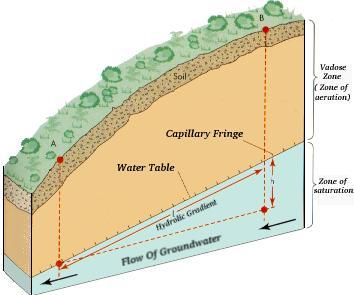
Groundwater Terminology
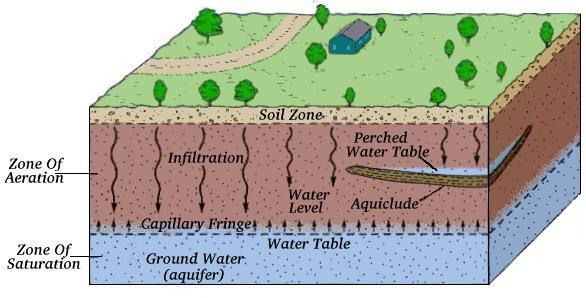
Zone of Saturation
The area where all the pore space in the ground is filled with water.
The difference in the elevation of the water table over a given length.
- Porosity
- The percentage of void space in a rock.
- Well sorted sand may have a porosity of 30% to 40%.
- Poorly sorted sand will have a lower porosity because the finer grained sediment fills the spaces between the larger grains.
- Most igneous rocks have very low to no porosity.
- Limestones may have a low or high porosity. If it has undergone erosion or dissolution, it may even have large caverns.
- Permeability
- The ease with which water can pass through a substance.
Clay Least permeable Hydraulic Head
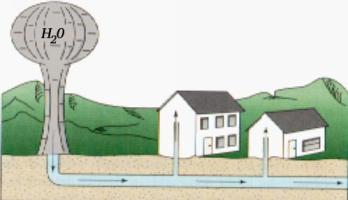
The term applied to water pressure due to the difference in the height of water in a closed system. Water tends to reach its own level. This phenomena may result in artesian wells and springs, and is used in providing water to municipalities via a water tower.