Global Warming

Global Warming
back to Contents of Entire Course...
Are Greenhouse
gasses responsible for changing the Earth's temperature?
Climate Variations
Consequences of Greenhouse Warming
Global Warming & Climate Change external links...
adapted to HTML from lecture notes of Prof. Stephen A. Nelson Tulane
University We know that we are adding greenhouse gases to the atmosphere.
By how much and at what rate are these gases changing the Earth's temperature?
Are Greenhouse gasses responsible for changing the Earth's temperature?
| Greenhouse Gases | |
|---|---|
| Gas and Effects | Relative Percentage |
|
60 % |
|
15 % |
|
12 % |
|
8% |
|
>5 % |
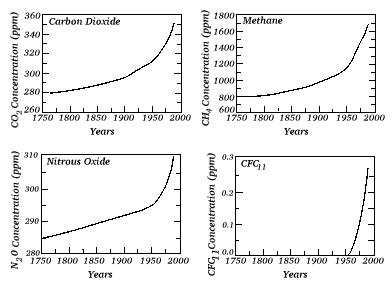
In the charts shown below, we can see how the concentrations of these gases have increased in the atmosphere during the last 250 years.
Climate Variations
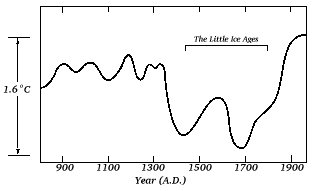
- In the last 1,000 years, the temperature has fluctuated by about 1.5° C in Europe. This change in temperature can have a large effect on agriculture, especially in areas where the weather is marginal for farming. In northern Europe, for example, killing frost during the growing season or cool summers would mean that crops would be inadequate to feed the population. During the period known as The Little Ice Ages, famine resulted from long term crop failures. It has been hypothesized that famine and the resulting weakened resistance of the population in Europe were partially responsible for the deadly Black Plague during the 1300's.
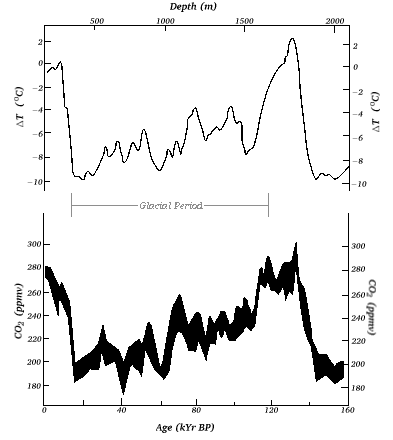
- The Earth's climate goes through a periodic long span fluctuation in temperature, known as glacial periods or Ice Ages. The last such Ice Age began approximately 110,000 years ago, and lasted until about 10,000 years ago. The glacial period reached its lowest temperatures and the maximum advance of the glaciers about 20,000 years ago. As can be seen from the chart shown below, carbon-dioxide contents of the atmosphere are lower during the glacial (cold) periods and higher during the interglacial (warm) periods.
- The most important factor for the development of glaciers is cool summers. Cool summers are necessary to ensure that the snow doesn't melt completely during summertime. Glaciers form when the snow left over from the previous winter gets added to by new snow. Over successive years of cold summers, when the snows do not melt completely, new winters snow gets added on top of the previous years snow, when the accumulation is thick enough a glacier develops.
- Glacier Ice, as it compacts, traps air within it. Newfallen snow has about 90% pore space. The pores are filled with air. As the snow compacts from the added weight of the new snow on top, some of this air escapes; however, some of the air gets trapped within the ice crystals that form from the compacted snow. Scientists can extract this air, and can use it to determine the contents and temperature of the atmosphere when the air was trapped within the ice. The temperature is evaluated by measuring the ratio of oxygen isotopes. Each summer as a result of melting and dust accumulation produces a darker layer in the glacier. The diagram above was determined by drilling in the Greenland ice cap. The gases were used to determine the composition of the ancient trapped atmosphere. The dark layers were counted to determine the age of the ice sampled. The oxygen isotope ratios were measured to determine the local temperature. Using this method, atmospheric data has been gathered for the last 150,000 years.
Consequences of Greenhouse Warming
- Increase in warming:
- Least effect in tropics.
- Greatest towards poles.
- Change in rain or snowfall:
- Wandering weather patterns.
- Increased Precipitation.
- Less rain in the summer in the U.S. midwest.
- Wetter in former Soviet Union.
- An increase in monsoon rains in India.
- Drier in Africa, China & Brazil.
- The intensity and number of storms will increase.
- The ocean currents may be modified
- Temperature on Earth is extensively modified by ocean currents. Changes in the currents will result in changes in temperature over land areas.
- sea level rise 1-3 feet by 2100
- Expansion of water due heating.
- Melting of glaciers.
- Will result in coastal flooding.
- Natural habitats will be destroyed
- Forests will start dying off.
- Wild animals in these regions will be unable to migrate to a more suitable climate. This is because of development and isolation.
- Agriculture may be helped or hurt.
- Depends on area - Siberia will be helped. Midwest U.S. will be hurt.
- Also depends on the ability of farmers to react fast enough to changing climate conditions.
- Water for irrigation and human use may be inadequate in dryer areas; groundwater reservoirs can only last so long. In some regions there will be less rainfall
- Diseases common to warm regions will be able to expand to new areas with the warming.
Global Warming Links
- NASA Climate News page: http://www.climatenews.com/
- The Union of Concerned Scientists have a global warming page: http://www.ucsusa.org/warming/index.html
- The Sierra Club page: http://www.toowarm.org/home.html
- The Environmental Protection Agency site on Global Warming: http://www.epa.gov/globalwarming/
- This is a page arguing against global warming: http://www.webaxs.net/~noel/gwarming.htm
- This page details the myths and misarguments by both sides of the global warming debate: http://members.aol.com/jimn469897/warming.htm
- A Collection of sites that NASA put together about global warming: http://gcmd.gsfc.nasa.gov/faq/globwarm.html
Climate Change Links
- The United Nations' climate change fact sheet: http://www.unep.ch/iuc/submenu/infokit/factcont.htm
- The Public Utilities Commission of Ohio has created an fairly comprehensive educational page on global climate change: http://www.puc.ohio.gov/consumer/gcc/index.html
- The U.S. Department of State's page on climate change; provides information on policies and legislature dealing with climate change. http://www.state.gov/www/global/global_issues/climate/index.html
- The current White House proposals about climate change: http://www.whitehouse.gov/Initiatives/Climate/main.html
The Illinois State Museum has an introduction to Ice Ages on their website: http://www.museum.state.il.us/exhibits/ice_ages/